
In today's competitive industrial landscape, operational efficiency separates market leaders from the rest. Global enterprises from automotive innovators like Audi and BMW to retail giants like Nike and Adidas depend on sophisticated enterprise software to orchestrate their complex operations. At the center of this digital transformation stands SAP (Systems, Applications, and Products in Data Processing), the world's premier ERP solution since its founding in Germany in 1972.
Why SAP MM Training Is Your Gateway To A Rewarding Career
Career changes are challenging, and one of the ways that you can assist yourself in making that transition is by enhancing your knowledge in ERP. One of the best ways to do this is by taking an SAP MM Course. MM is short for Materials Management which is one of the most important components of any modern supply chain. With new businesses opening up across the globe, there are few things that can make you as employable as an SAP MM certification. This qualification can get you jobs in more or less any industry that pays very well.
We at ERPVITS have developed a unique method of training that takes complete novices and trains them to be industry-ready SAP professionals through our SAP MM training programs. Thanks to our training method, you can be sure that your SAP MM training is going to be more than an academic exercise. You will learn and develop skills that will be in demand in the real world.
Understanding SAP's Foundation: The R/3 Architecture
Taking into consideration the structure of the SAP system is essential before starting the SAP MM tutorial. The SAP system is built on top of one of the most sophisticated client-server structure known as R/3. The R/3 system is the foundation of all business processes.
Overview of the R/3 Framework
- Real-Time: The system conducts all transaction and data processes in a real-time environment.
- Presentation Layer: The front end of the system. This is where a user enters transaction codes and where system interactions occur.
- Application Layer: This is the system's brain. It processes business logic from the user's requests and communicates to the database.
- Database Layer: This is the layer where data is stored and accessed through authentication means.
The Strategic Importance Of Materials Management
The SAP MM full form is only the beginning of the acronym's meaning. It explains the importance of why the SAP MM (Materials Management) professionals are in high demand. The main area of focus for MMs on consulting is, in fact, somewhat straightforward. It is managing the "right" materials, i.e., materials arriving at the right time, in the right quantity, and at the right cost.
This is especially true in a manufacturing environment; if even one essential ingredient is absent, the entire production line is held up. It may be difficult to recover from (i.e. fiscal loss), but for this reason and no other, the value of SAP MM certified professionals is in managing:
- Strategic Procurement: Developing and sustaining vendor relations and negotiating the most favorable buying terms.
- Inventory Management: Keeping comprehensive and accurate records of each and every item that enters and/or exits the facilities.
- Stock Levels: Neither production halting shortages nor excessive stock that spells out fiscal outlay.
The demand for this in the market is consistent. In a SAP implementation project, 30-40% of the consult team primarily works on and focuses on MM, while the other 60-70% works on all other modules, including (but not limited to) SAP Sales and Distribution (SD) , Financial Consulting (FI), and Human Resources (HR).
Mastering the SAP MM Enterprise Structure
As part of your SAP MM training, one of the first major concepts you need to learn is the Enterprise Structure. It is not only important for your course, but this is also a common interview question. You need to be able to describe this hierarchy.
The Organizational Hierarchy
- Company/Client: The topmost level that indicates a business group or entire corporation.
- Company Code: The smallest unit of the organization that can create a set of financial statement, including accounts receivable, accounts payable, and other accounting documents.
- Plant: Physical location where the production and/or inventory of materials is done.
- Storage Location: Plant divisions that are set aside for the holding of inventory materials.
- Purchase Organization: The business unit for purchasing that is responsible for the buying of materials and the establishment of contracts with suppliers for one or several plants.
Career Pathways in SAP: Functional vs. Technical Specializations
Functional Consultants (MM, SD, FI, QM)
These roles act as a glue between the business and tech worlds. As an MM consultant, you adapt the system to the needs of the procurement department, which involves configuring the systems to match various business processes.
Technical Consultants
ABAP Developers: Customizers who code based on specific needs. Basis Administrators: Infrastructure experts who look after server landscapes and system health.
Project Lifecycle Mastery: From Implementation to Support
- Implementation Projects: Deciding to transform functions on the platform from scratch.
- Rollout Projects: Extending SAP to global locations from a successful implementation geography.
- Support and Maintenance: Continuous support to business users for everyday operational queries.
The System Landscape: Your Path to Production
Your testing ground for configuration and initial testing.
Where business users verify that systems meet operational requirements.
The live environment where actual transactions occur.
Why ERPVITS Stands Apart in SAP MM Training
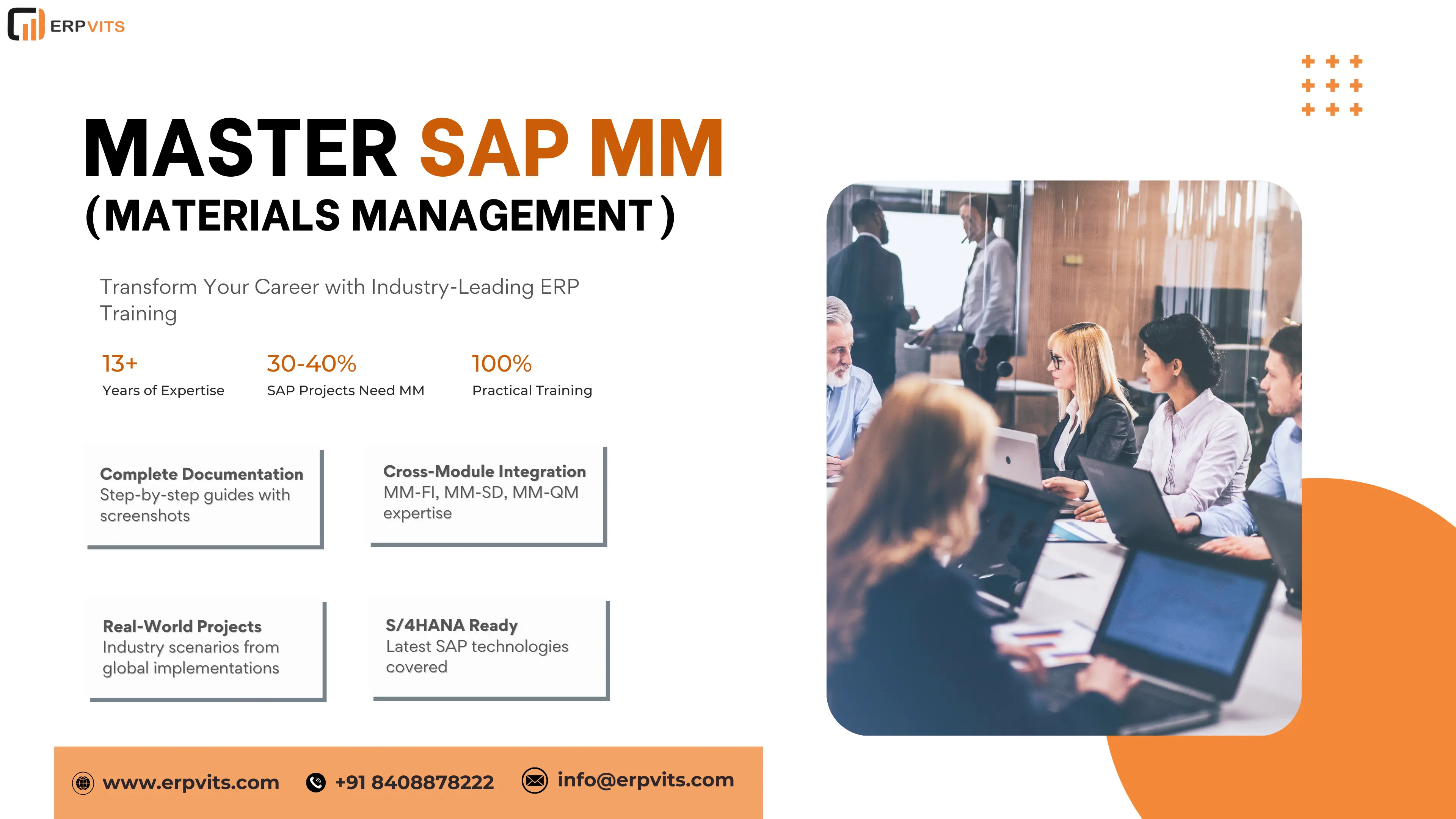
When you enroll in our SAP MM certification program, you're choosing an institution that prioritizes practical, career-focused education. Our lead instructor contributes 13 years of hands-on experience, including team leadership roles and participation in numerous global implementation and rollout projects.
What Sets Our SAP MM Course Apart
- Comprehensive Documentation: Step-by-step practical notes with screenshots.
- Advanced Integration Knowledge: Covers sophisticated topics like MM-QM integration.
- Cross-Module Expertise: Essential interactions with FI and SD modules.
- Real-World Scenarios: Actual business cases from various industries.
Ready To Transform Your Career?
Join ERPVITS today and discover why our SAP MM course graduates consistently secure positions at leading organizations worldwide. Your journey to becoming a certified SAP MM professional starts here.
Enroll now in our comprehensive SAP MM course online and take the first step toward a rewarding career in Materials Management!