
Essential SAP C4C Technical Competencies for Modern CRM Consultants
In today's world, C4C SAP Cloud is one of the best solutions when it comes to Customer Relationship Management and is widely used across the globe. To stay ahead of the competition, having broad in-depth knowledge of the technical aspects of the C4C SAP Cloud through SAP C4C Training and satisfying the needs of the client is of utmost importance, and investors as well as clients alike, appreciate this.
1. Creation and Expansion of a Customer Specific Business Object
This is the simplest and most easily achievable example of a Business Object that fulfills the specific needs of the client. To achieve this gap scenario, one needs ample knowledge of the SAP C4C data model alongside the proficiency of being able to extend standard objects without changing any of the core functionalities. Getting familiarized with the Business Object Builder tool is crucial. Mastering the tool means knowing the relations between objects and incorporating the proper validation rules.
A Business Object is created when its components are defined, business rules are defined and scripted and subsequently integrated into pre-existing workflows. For successful functioning of approved implementations, knowing about the lifecycle management, status schemes, and custom objects is crucial.
2. Integration with On-Premise and Third-Party Systems
In today's business and competition, enterprises hardly function in isolation and so system integration becomes a salient technical scenario. For this reason, C4C Consultants have to know various integration patterns such as point-to-point branching, middleware approaches, and API integration. In this case, they are required to work with SAP Cloud Integration, relevant REST and SOAP knowledge, and data synchronization.
Some of the more central aspects include authentication protocols, data management as well as transformation, and various aspects of error handling. It is advisable that the consultant in question is equipped with integration monitoring as well as troubleshooting skills as a means to proactively safeguard data integrity and seamless flow within systems. To gain these skills effectively, professionals should consider SAP C4C Technical Training, which covers hands-on integration practices and real-world troubleshooting scenarios.
3. Advanced Workflow and Business Process Implementation
There are complex business processes which need advanced workflow implementations which are beyond the system's configuration capabilities. This scenario has multi-step approval processes, conditional logic, and escalation. For the context of seamless, revolutionary workflows, Process and Forms designer tool must be understood.
In the workflows, system users and consultants need to integrate and streamline complex systems such as task management, advanced notifications, and access streamlining through role boundaries. Moreover, business processes are better automated with the other features such as parallel processing, loop handling, and exception management systems.
4. Development of Custom UI and Screen Personalization
The experience of utilizing the workstation is one of the most important factors for the adoption of a system. The custom UI scenario is one of the most important technical scenarios for the case. This scenario is accomplished with the help of the UI Designer facility by personalizing screens according to the principles of responsive design and optimum user experience for various devices.
The ability to work with embedded components, custom controls, and external UI interfacing are the most important for the screen adaptability to remote devices and synchronization which are within the design principles of SAP Fiori.
5. Development of Advanced Analytics and Reporting Solutions
Data-driven decision making requires sophisticated reporting capabilities that go beyond the standard functionality. This scenario is characterized by the construction of custom reports, embedded analytics, and interactive dashboard development. A Consultant must know the tool and its integration with SAP Analytics Cloud at this stage.
The technical skills at this level are working with the calculated fields, drill down capability implementation, and real-time analytics construction. The skill in performance optimization and data modeling is crucial at this level for the effective management of large volumes of data. Enrolling in a comprehensive SAP C4C Course helps professionals build these advanced skills and apply them effectively in real-world business scenarios.
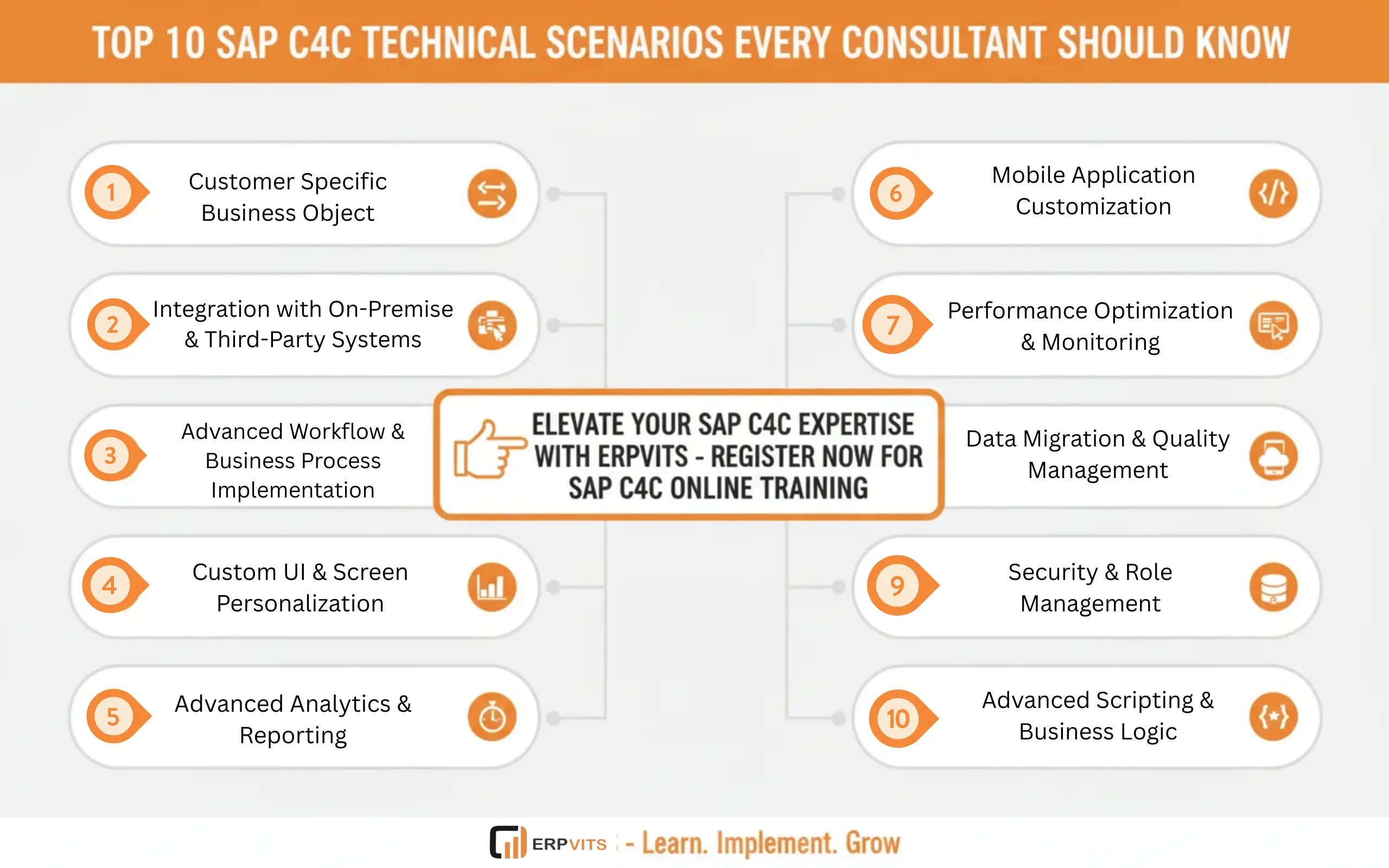
Top 10 SAP C4C Technical Scenarios
6. Configuration and Customization of Mobile Applications
The ever-increasing requirements of the mobile workforce have made the configuration and customization of mobile applications a very important technical scenario for the case at hand. This scenario is spelt out in the SAP C4C mobile framework with its offline capabilities and the mobile-to-cloud instance seamless synchronization.
It's important for consultants to understand and master mobile UI design, implement basic location services, and understand what mobile features to use. Understanding mobile push notification systems alongside mobile security protocols is important for effective mobile solutions.
7. Security Implementation and Role Management
Enterprise security implementation, and particularly role based security, C4C is a complex area as it involves configuring role based access control. This case is complex as it involves configuring role based access control, data security, and compliance to a set of regulations for an industry domain. Understanding organizational management and business role assignments, and fine-grained access control is of utmost importance.
Technical implementation of single-sign-on systems, user authentication and audit log tracking is trivial, but wire data protection processes must be designed in accordance with applicable regional regulations.
8. Performance Optimization and System Monitoring
To achieve effective system performance, one must understand various techniques of system optimization and performance monitoring. This case includes performance bottleneck identifications, developing caching techniques, and execution of business logic optimization. Understanding system utilization of resources and systems planning is critical to scalable implementations.
Core capabilities include Advanced system log analysis, implementation of performance monitoring systems, and execution of periodical health checks. Deep knowledge of database optimization techniques and efficient system query design greatly contributes to overall system performance.
9. Data Migration and Quality Management
Most successful implementations of SAP C4C involve migrating all pertinent data from legacy systems to new ones. Relating to Systems Engineering, this scenario focuses on data migration strategies and tools, data cleansing and refurbishment, and system interconnection.
The consultant has to bring sides of data migration strategies, such as one-off and phased migration, into cohesive structures. It is helpful to know elements of data migration imposition such as data validation, duplicate elimination, and maintaining control of referential integrity to complete the implementation.
10. Advanced Scripting and Business Logic Implementation
If the configuration of SAP C4C is considered the "box," business requirements sometimes dictate the creation of "custom box" solutions, thereby triggering the need for scripting. This involves server-side business logic scripts, client-side validations, and ABSL scripting.
Scripting on Data Integration and External Systems have the following nuances: mechanisms of event handling, some scripting of advanced calculations and other business logic integrations to outside web systems, and debugging of the systems after devices.
Adhering to these technical scenarios requires holistic training and practice. Our unique instructors have built ERPVITS training modules guided by real-world challenges in systems and data engineering to provide the best SAP C4C training programs.
Register now for our comprehensive SAP C4C certification courses and gain the expertise needed to excel in these technical scenarios. Our expert instructors provide personalized guidance, practical exercises, and industry insights that prepare you for successful SAP C4C implementations.
Join our WhatsApp channel, for daily SAP C4C tips, training updates, and exclusive resources!
Conclusion
These ten technical scenarios encapsulate the primary skills an SAP C4C consultant is expected to possess. Each scenario consists of its own set of features ranging from custom development, system integration, and system integrator to configuration, which all contributes to customer engagement success. Gaining concepts through theory coupled with practical work will help you tackle the SAP C4C consultant world easier. With a lot of practice, the time spent on training and acquiring a certification will become worthwhile by unlocking advancement in your career and impressive services for clients.