
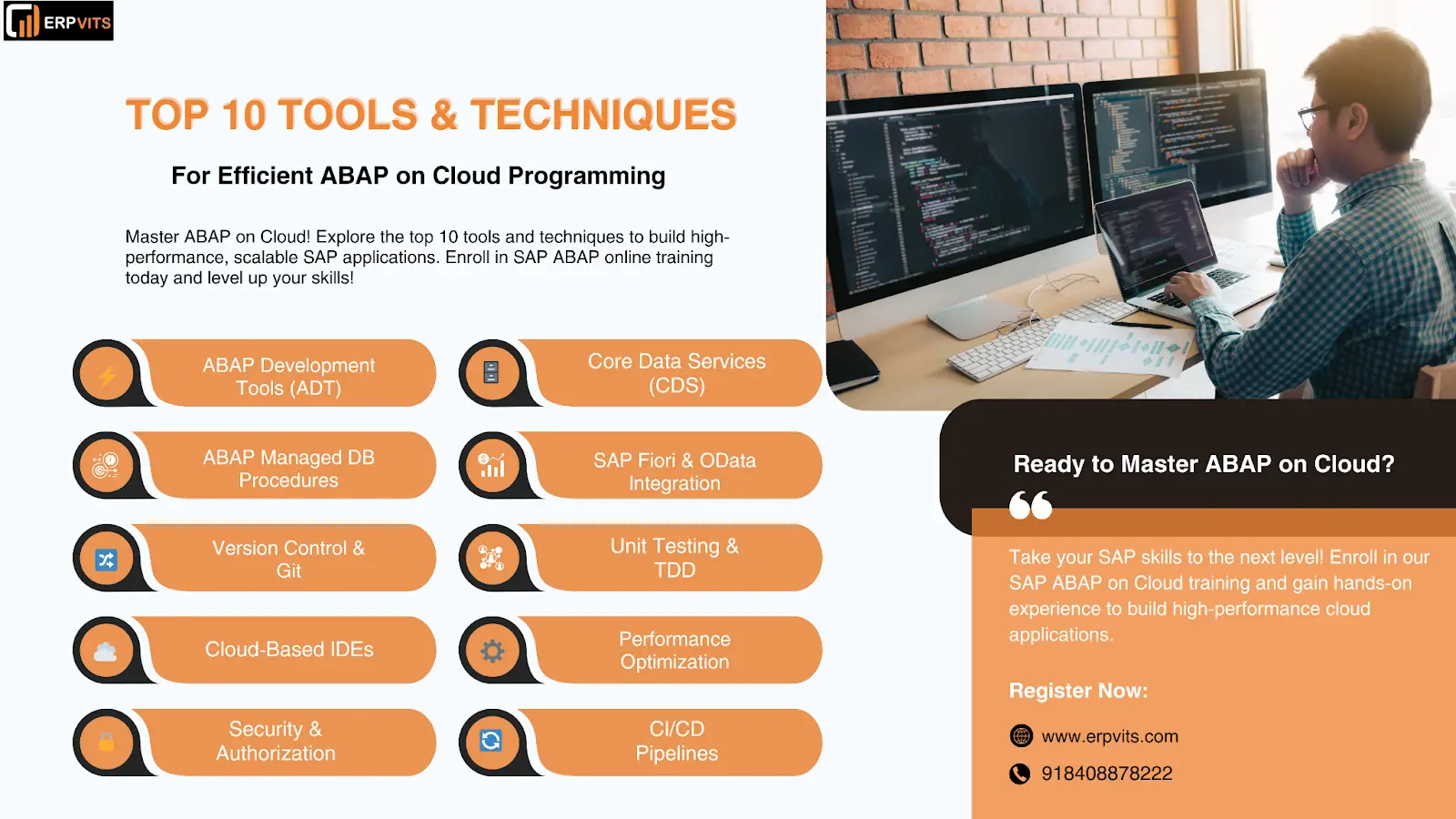
The SAP world is changing fast, and with cloud-based solutions becoming more common, ABAP developers need to update their skills to keep up. ABAP on Cloud isn't just a trend anymore—it's the future of SAP development. By using the right tools and techniques, developers can build applications that are fast, scalable, and efficient in the SAP Cloud environment. In this article, we'll look at the top 10 tools and techniques for ABAP on Cloud, and also show how you can improve your skills through SAP ABAP online training and courses.
10 Key Tools and Techniques for SAP ABAP Programming
1. ABAP Development Tools (ADT) in Eclipse
The first step to effective ABAP development on Cloud development is to master ABAP Development Tools (ADT) within Eclipse. ADT replaces the standard SAP GUI for ABAP development and offers a contemporary rich, multi-faceted environment.
Key features ADT:
- Integrated debugging and analysis of code
- Advanced syntax highlights and code completion
- Easy integration seamless integration SAP HANA and cloud services
ADT lets developers write more efficient, maintainable code that improves overall efficiency in cloud-based applications.
2. Core Data Services (CDS) Views
Core Data Services (CDS) are essential for effective modeling of data for ABAP on the Cloud. CDS lets developers create highly semantically rich data models which are optimized for SAP HANA.
Benefits of CDS in cloud-based development:
- Reduces the requirement for complicated SQL queries
- Annotations are supported in SAP Fiori and OData services
- Improves performance by using database-level calculations
3. ABAP Managed Database Procedures (AMDP)
AMDP is yet another powerful cloud-based tool that can be used for ABAP development. With AMDP developers can create database-specific procedures within ABAP which execute in HANA database. This permits calculations that are extremely complex to be carried out on the level of the database, which improves the performance.
Benefits of AMDP:
- High-performance data processing
- Reduction of burden on the server for application
- Seamless integration CDS views
4. SAP Fiori and OData Services Integration
Modern SAP applications are heavily dependent in SAP Fiori interfaces as well as OData services. In order to use ABAP on Cloud it is crucial to be aware of the best way to present CDS view views as well as AMDP processes as OData services that can be used for Fiori consumption.
Key techniques include:
- Utilizing @OData.publish True annotation for views in CDS
- Application of UI annotations to display control of UI annotations Fiori applications
- Optimizing queries to decrease the time to respond
5. Version Control and Git Integration
Cloud development that is efficient requires strong version control. Git is extensively employed within SAP Cloud projects to manage the changes made to code in a collaborative manner. ADT in Eclipse integrates Git integration, which allows developers to:
- Changes to track code
- Manage multiple development branches
- Work effectively with other developers
Through mastering the art of the art of version control, ABAP developers can ensure high-quality code and a smooth project delivery cloud-based scenarios.
6. Unit Testing and Test-Driven Development (TDD)
Testing is an essential component in ABAP for Cloud programming. Tools such as ABAP Unit allow developers to automate testing, making sure that the code is secure and adaptable. Implementing Test-Driven Design (TDD) enhances quality of code by writing tests prior to implementation.
Benefits of TDD in cloud-based projects:
- Bugs that are detected early can be identified
- Code that is cleaner and more easily maintained
- Trust in cloud-based applications
7. Efficient Use of Cloud-Based Development Environments
Cloud-based development environments, like SAP Business Application Studio (BAS) offers the complete set of tools needed by ABAP developers. BAS includes:
- A web-based development platform
- Environments that are pre-configured that are compatible with ABAP and Fiori
- Integration seamless seamlessly SAP HANA Cloud
Utilizing cloud-based IDEs lets developers work from anywhere, while ensuring efficiency and collaboration.
8. Performance Optimization Techniques
For cloud-based environments optimizing performance is essential. Techniques include:
- Utilizing CDS annotations to create aggregations on the database level
- Reducing loops that are unnecessary and nesting selects
- Utilizing AMDP and HANA-specific functions for complicated calculations
The ability to master these techniques makes sure that ABAP applications function smoothly on cloud platforms and provide a superior user experience.
9. Security and Authorization in ABAP on Cloud
Security is an important issue for any cloud-based application. ABAP Cloud is a cloud-based application that Cloud allows advanced authorization methods such as access control that is based on roles and precise CDS security view.
The key steps are:
- Using @AccessControl.authorizationCheck annotation for CDS views
- Determining roles and permissions for sensitive data
- Ensuring secure OData services for Fiori apps
10. Continuous Integration and Deployment (CI/CD)
The most modern ABAP for Cloud projects adhere to DevOps practices, which includes pipelines for CI/CD. Tools such as Jenkins and SAP Continuous Integration software let developers to automatize testing development, building, and deployment procedures.
The benefits of CI/CD for ABAP Cloud projects:
- Faster deployment cycles
- Minimized errors made by hand
- Collaboration between teams from operations and development
Conclusion
The move toward ABAP on Cloud requires a whole new set of tools, skills and methods. From understanding ABAP Development Tools (ADT) and CDS views to using AMDP, Fiori integration, and CI/CD pipelines, these 10 tools and techniques form the basis for effective cloud-based development.
For ABAP developers keeping up with the cloud world requires continuous learning and knowledge. It doesn't matter if it's improving the performance of a system, ensuring security or integrating with the latest SAP Fiori applications, these methods are crucial to building high-performance, scalable cloud applications.
Take the leap in your SAP career!
Enroll now in our SAP ABAP on Cloud training, join our SAP ABAP online course, and gain hands-on experience that will make you industry-ready.
Join ABAP Cloud Course