
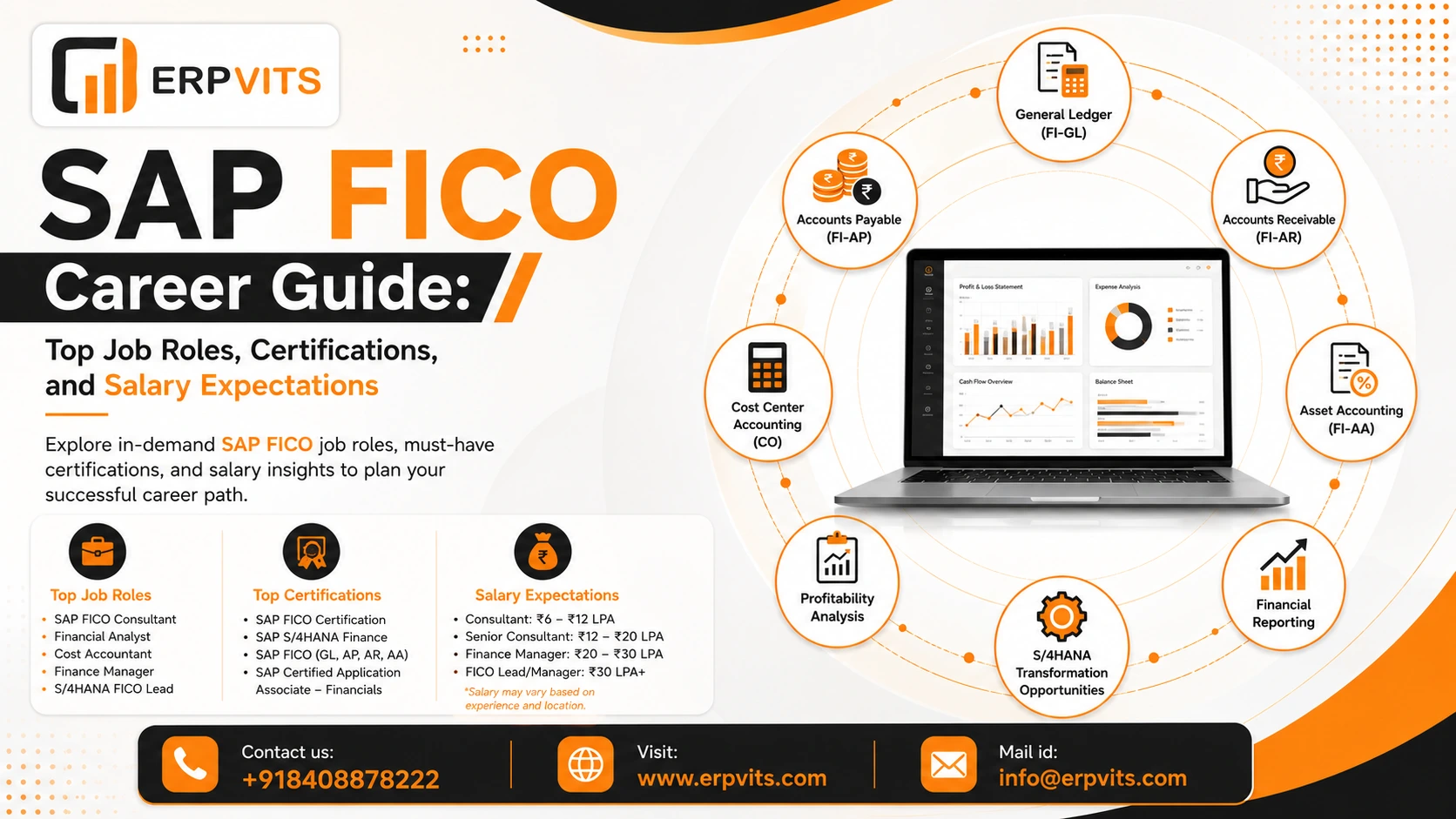
SAP FICO Career Guide: Top Job Roles, Certifications, and Salary Expectations
If you've ever considered career options in technology and finance it's likely that you've heard of SAP FICO several times. It's among the most sought-after SAP modules, currently powering the financial backbone of a multitude of businesses across the globe. Companies of all sizes including mid-sized companies to multinational conglomerates, depend on SAP FICO to keep their financial operations transparent, accurate and audit-ready. This guide will walk you through all you need to know about SAP FICO, starting with the basics of what SAP FICO is actually, what SAP FICO jobs are available, the SAP FICO certification paths that are worth your time, and the salary you could realistically hope to earn at every level of your professional career.
What is SAP FICO?
SAP FICO stands for Financial Accounting (FI) and Controlling (CO), two essential modules of SAP ERP that work together to oversee the financial information of an organization's reports, as well as the management of internal costs. Together, they are an integral part of one of the most commonly utilized modules across different industries, as almost every company, irrespective of size or industry, requires strong financial control. Contrary to standalone accounting software, SAP FICO is deeply integrated within a business's ERP system, which means that any single transaction, for example an invoice to a customer or a vendor's payment, will automatically update the financial records, cost centers and management reports in a single step.
An overview of SAP FI (Financial Accounting): SAP FI handles all external financial reporting needs, like general ledger accounting, accounts payable, accounts receivable, asset accounting, and reconciliation of bank accounts. It is responsible for ensuring that the firm's financial statements are precise as well as compliant and ready for audits and regulatory examination. Fundamentally, FI is a program that keeps the firm's books in order. It also facilitates closing of financials, tax reporting procedures, and consolidating accounts across different businesses or subsidiaries. This is essential for multinational corporations operating in diverse tax jurisdictions and currencies.
A brief overview of SAP CO (Controlling): While FI is looking outward towards shareholders, regulators as well as auditors, CO examines inward. Controlling concentrates on internal management reports and cost center accounting. It also includes profit center accounting and internal order as well as profitability analyses. It assists management in understanding how money is spent in which areas, what departments earn a profit and how cost reductions can be made. CO assists in the process of forecasting and budgeting, providing decision makers with the ability to plan for future expenditure and evaluate the actual performance against these plans in close-to-real time.
The reason companies rely on SAP FICO: businesses depend on SAP FICO because it integrates financial data with all other business functions, such as sales, production, procurement and HR, all in real-time. The integration removes the need for duplicate data entry, minimizes errors, and gives leaders one source of truth to make financial decisions. Beyond the efficiency aspect, this real-time monitoring also enhances internal control which makes it easier to identify fraud, verify compliance with regulatory requirements and react quickly in the event of financial risk before they grow into bigger issues.
Why Choose a Career in SAP FICO?
If you're considering your options for a career, SAP FICO offers an appealing mix of growth, stability and cross-industry significance. This is a career path which rewards both technical interest and financial knowledge and is a great choice for individuals with a variety of professional backgrounds looking to break into SAP FICO jobs.
Increased demand for SAP professionals: as more businesses move to SAP S/4HANA, the demand for highly skilled FICO consultants to handle implementation, configuration and support has increased rapidly. Numerous companies are also making investments in permanent SAP support teams, even after implementation, which means they can create permanent, long-term employment opportunities rather than only short-term projects.
Industries employing SAP FICO specialists: SAP FICO experts aren't restricted to a single industry. Retail, manufacturing, banking, pharmaceuticals, petroleum and natural gas services, information technology and even government institutions depend on SAP FICO consultants. The broad range of applications means that you're not confined to any one sector, and you are able to frequently switch between different sectors and carry your entire expertise with you.
Future scope of SAP FICO careers: with the constant shift towards cloud-based ERP systems as well as the use of AI to automate finance, SAP FICO professionals who constantly improve their skills, particularly with S/4HANA as well as Fiori, will be highly employable in the years to come. Since automation has taken over mundane tasks, the job of the SAP FICO consultant is also shifting towards more strategic tasks including optimization of processes as well as data analytics and providing advisory support to the leadership team.
SAP FICO Analyst
What are the roles and responsibilities of an SAP FICO Analyst? They generally assist in daily system operations, identify issues raised by users, prepare financial reports and aid in the testing of new configurations before going live. They are often the primary point of contact in the event that there is a problem with the system, making swift diagnosis essential to their job.
Analysts must have an understanding of accounting principles, basic SAP configuration and navigation skills and a sharp analytical ability to spot and fix any differences in financial information. A working knowledge of ticketing systems as well as a systematic approach to documenting are important, as analysts are often required to document recurring issues and solutions.
SAP FICO Functional Consultant
Functions and responsibilities: Functional consultants are accountable for identifying requirements from the business, adjusting the SAP FI and CO modules to meet the requirements, and then helping the client through tests and going live. They are the mediators between the business and the technical side, making sure that the information built into the system actually represents the way that the business wants to conduct its finances.
SAP FICO Project Manager
The responsibilities and roles at the upper levels: the SAP FICO Project Manager is responsible for the entire process of implementation including planning timelines, managing budgets as well as coordinating between technical and functional teams, while making sure that the project is completed within the timeframe and on budget. This position requires excellent leadership and stakeholder management abilities, as project managers are usually those who report progress directly to senior clients and handle any issues that occur during the process of rolling out.
Skills Required for SAP FICO Jobs
Technical Skills
SAP configuration knowledge: a skilled SAP FICO professional understands how to modify the chart of accounts, posting periods, tax procedures, and other settings in the SAP system. This includes knowing how changes to configurations affect related processes, ensuring that an unintentional change won't cause damage to another process downstream.
Integration with other SAP modules: FICO isn't a stand-alone module, professionals must be aware of the way it works with other SAP modules such as MM as well as SD in order to facilitate smooth and seamless end-to-end business processes. For instance, knowing the way a goods receipt within MM causes an automated financial posting in FI is crucial to resolve cross-module issues.
Functional/Domain Skills
Accounting and finance fundamentals: an understanding of accounting principles, financial statements and cost accounting concepts is vital, as SAP is merely an instrument that can automate these procedures. Without this understanding it can be difficult to set up the system in the correct way or communicate the financial outcomes to everyone involved.
Reporting and analysis: the capability to produce, interpret and present financial reports is essential, as much of the value SAP FICO consultants provide comes from transforming raw data into useful information. This usually involves using standard SAP reports, in addition to creating customized reports that are tailored to meet specific needs of management.
Soft Skills
Communication: consultants frequently interact with business and finance stakeholders, finance teams as well as technical developers, so being able to explain complex configurations in plain terms is crucial. Communication skills are also essential to keep expectations in check during long project implementations, when delays or changes to scope are not uncommon.
Problem-solving: because real-world scenarios aren't always a good fit for standard SAP templates, strong problem-solving abilities assist consultants in designing solutions that work and are custom. This usually involves the ability to balance what's technically feasible in SAP with what a company actually requires.
SAP FICO Certifications
SAP Certified Application Associate - Financial Accounting
Exam information: this certification tests your understanding of fundamental FI procedures, such as general ledgers, accounts payable and the configuration of accounts receivable. It usually covers topics such as document posting, closing financial procedures and the basics of asset accounting.
There isn't a mandatory requirement, but candidates usually benefit from previous hands-on SAP FI experience or the successful completion of relevant training courses prior to taking the test, as the exam questions typically require familiarity with actual system navigation.
SAP Certified Application Associate - Management Accounting
Exam description: the certification is focused on the Controlling aspect, cost center accounting, internal orders, as well as profitability analysis. It validates the ability to set up as well as manage internal reporting systems. It's a great addition to an FI certification for those who wish to demonstrate their knowledge across both aspects of FICO.
Advanced/Specialist Certifications
SAP S/4HANA Finance certifications: as businesses shift to S/4HANA, certifications that are specific to this latest platform are becoming more valuable and cover subjects such as the Universal Journal and real-time financial reporting. A certification specific to S/4HANA can make you stand out, as numerous organizations are searching for consultants who understand the latest architecture, not only the old ECC system.
How to Prepare for SAP FICO Certification
Recommended study materials: official SAP study materials, in conjunction with a well-reviewed guide from a third-party, will help you structure your exam preparation according to the syllabus. Real-world configuration exercises in conjunction with theoretical studies can result in better retention as opposed to reading alone.
Online training platforms that provide self-paced or instructor-led SAP FICO training courses offer the opportunity for hands-on practice which can be better than simply studying the theory. A lot of these platforms provide access to a practice SAP system which is among the most effective resources for gaining confidence prior to the exam.
Practice tests and mock exams: taking timed mock tests helps you become familiar with the format and helps you spot weak areas prior to the actual certification exam. Reviewing your answers for errors, rather than simply checking your score, is usually what will make the biggest difference in the final exam score.
SAP FICO Salary Expectations
Entry-level salary: freshers with less than two years of work experience generally start in the low-to-mid range, but have the potential to increase their salary quickly once they gain exposure to real-time projects. Completing a certification earlier in your career may help push the starting offer slightly higher.
Mid-level salary: professionals with 3-7 years of work experience, specifically those who've managed implementation projects, receive higher salaries. Experience with complete project cycles and client work is an important factor when it comes to salary negotiations.
Senior-level/consultant salary: senior consultants and those managing large-scale projects or client relationships often reach the top end of the pay scale, especially when paired with strong certifications. Many professionals at this level are also able to transition into freelance and independent consultancy which can increase their earning potential.
Salary by country:
| Country | Salary Outlook |
|---|---|
| USA | SAP FICO professionals typically earn high salaries, which reflects the high demand and expense of specialized ERP expertise. Salary levels also differ according to whether the position is in a consultancy company or an in-house corporate team. |
| India | India is still a key centre for SAP implementation and maintenance, so salaries, although lower than Western markets, offer great opportunities compared to local averages. India is also home to many international SAP support centers that offer stable and long-term career prospects. |
| UK/UAE | Both the UK and the UAE provide competitive salaries specifically for those with experience in S/4HANA or expertise in a specific industry. The UAE in particular has seen an increase in demand because of large-scale ERP transformation initiatives across private and public sector organisations. |
How to Start a Career in SAP FICO
The educational background required for SAP FICO professionals typically comes from a finance, commerce or accounting background. However, those with an MBA with a focus on Finance or an IT background with a passion for finance are also able to make the transition. An interest in both systems and numbers tends to be a more reliable indicator of success than any one qualification.
Step-by-Step Career Roadmap
Step 1: Learn Finance Fundamentals. Develop solid foundations in financial and accounting concepts prior to tackling the SAP tool itself, because the tool can only be as effective as the knowledge you have of the things it's doing.
Step 2: Get SAP FICO Training. Enroll in a structured course of training, either in-person or online, to understand the module's configuration and capabilities, ideally one that provides access to a live training system.
Step 3: Earn Certification. Get an authentic SAP certification to prove your capabilities and attract recruiters and employers, using it as evidence of your commitment, not simply a checkbox on your resume.
Step 4: Gain Practical/Project Experience. Search for internships, support projects or entry-level positions in which you are able to apply your skills in real-world business situations, as real-world experience is often what makes a difference in candidate interviews.
Step 5: Apply for Entry-Level Jobs. Begin applying to analyst and junior consultant roles, using your experience and certification to boost your candidacy, and be willing to take on maintenance or support roles as a means of building experience prior to moving onto the implementation phase.
SAP FICO continues to be one of the most rewarding careers for finance professionals who want to mix their industry knowledge with highly sought-after technical skills. If you're just beginning your journey or want to get more specialized in S/4HANA, this roadmap should provide you with an easy, practical way ahead. And with regular upskilling, a career in SAP FICO will provide stability over time across different industries and regions for many years to come.