

The Cash Journal in SAP FICO is a powerful tool designed to record and manage petty cash transactions within an organization. It streamlines cash handling through a systematic approach to recording receipts and payments, tracking balances, and generating accurate financial reports. With its user-friendly interface, businesses can ensure transparency, reduce errors, and maintain compliance with accounting standards.
If you're looking to master this feature along with other essential financial processes, our SAP FICO online training program provides comprehensive hands-on instruction. From configuration to real-world scenarios, you'll gain the skills needed to manage financial operations efficiently and advance your SAP career.
Key Features of Cash Journal in SAP
1. Simplified Cash Transactions Recording
The Cash Journal in SAP is specifically designed to handle low-value cash transactions such as petty cash expenses, employee reimbursements, and daily cash operations. Instead of maintaining manual registers or spreadsheets, every transaction is recorded systematically within SAP, minimizing errors and ensuring accurate documentation.
2. User-Friendly Interface
Unlike complex financial posting screens in SAP, the Cash Journal offers a simplified and intuitive interface where users can easily record transactions. This makes it ideal for cashiers and non-technical staff who may not have extensive accounting knowledge, significantly speeding up the data entry process.
3. Integration with Financial Accounting (FI)
One of the most powerful aspects of the Cash Journal is its tight integration with the SAP Financial Accounting (FI) module. Each entry in the Cash Journal automatically updates the General Ledger (G/L), Accounts Payable (AP), and Accounts Receivable (AR) based on the transaction type, ensuring consistent financial data across the system.
4. support for Multiple Cash Journals
SAP allows organizations to create multiple cash journals based on business requirements. For instance, you can set up separate journals for different company codes, currencies, or business units. This flexibility ensures that cash handling is organized and managed according to the organizational structure.
5. Automatic Account Determination
When transactions are recorded in the Cash Journal, the system automatically identifies and assigns the appropriate General Ledger accounts. This not only saves time but also reduces the risk of accounting errors by eliminating manual account selection.
Importance of Cash Journal in Financial Accounting
The Cash Journal in SAP FICO plays a crucial role in streamlining day-to-day cash transactions within organizations. It ensures accurate financial reporting and smooth cash flow management. Key points highlighting its importance include:
- Efficient ManagementTrack, record, and reconcile petty cash transactions in real-time.
- Improved AccuracyAutomates posting to reduce manual effort and ensure compliance.
- Enhanced Financial ControlBetter visibility into cash movements to prevent misuse.
- Seamless IntegrationSeamless data flow across the finance landscape (AP, AR).
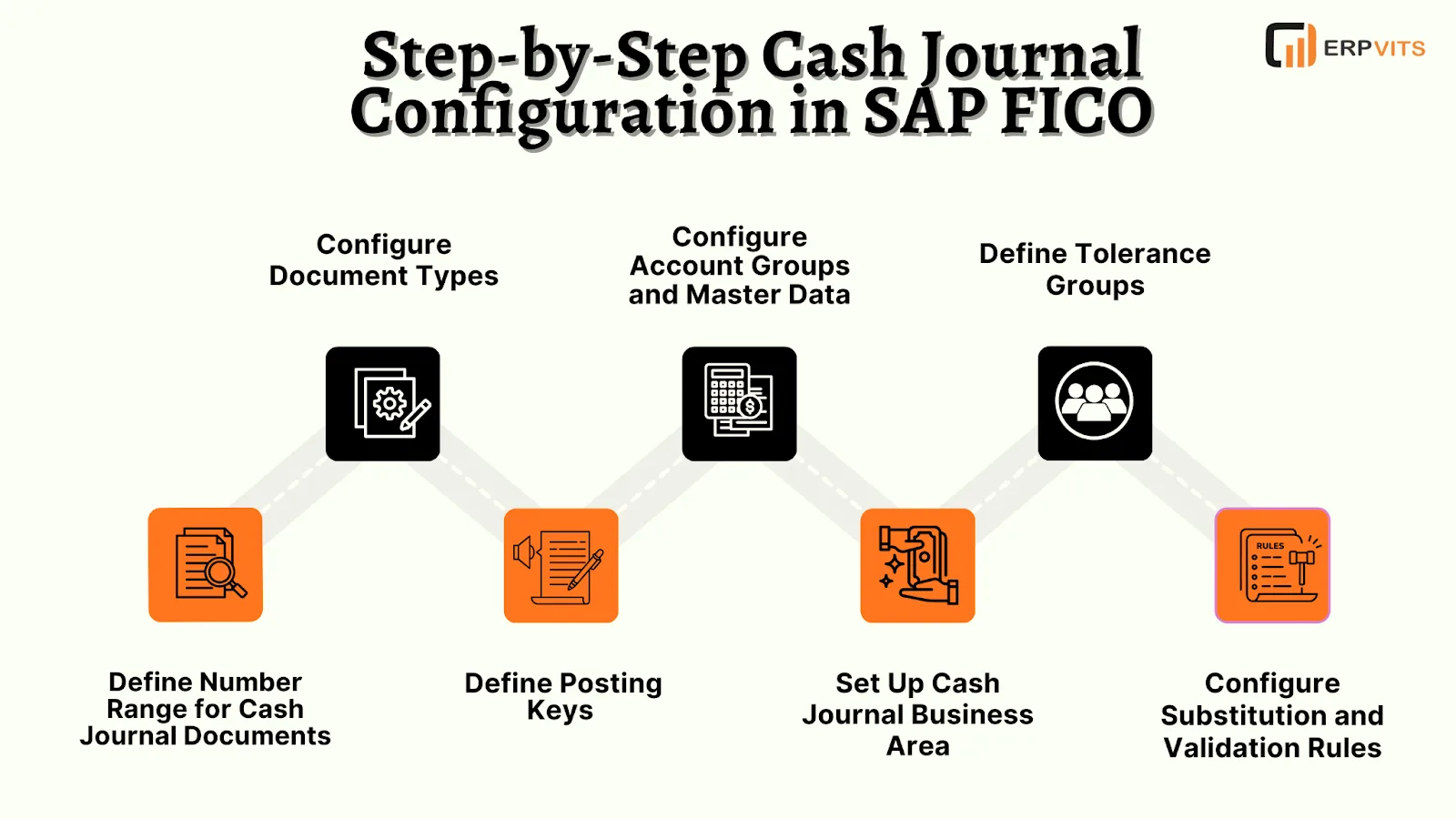
Step-by-Step Cash Journal Configuration in SAP FICO
1. Define Number Range for Cash Journal Documents
Purpose: Create unique document number series for cash journal entries
Configuration: Set number ranges (e.g., 51000000-59999999)
Assignment: Link number range to document type (e.g., KR, KZ)
2. Configure Document Types
Setup: Define document types for cash transactions (KR, KZ, KG)
Parameters: Set number range assignment, account types allowed, posting keys
Control: Configure field status and validation rules
3. Define Posting Keys
Purpose: Create/modify posting keys for cash transactions
Standard Keys: 40 (Debit G/L), 50 (Credit G/L), 01 (Customer Debit), 11 (Customer Credit)
Customization: Configure field statuses and mandatory fields
4. Configure Account Groups and Master Data
Setup: Define account groups for cash, bank, and petty cash accounts
Master Data: Create G/L accounts (FS00) for cash management
Field Status: Configure mandatory and optional fields
5. Set Up Cash Journal Business Area
Configuration: Define business areas if required for reporting
Assignment: Link business areas to cash journal transactions
Reporting: Enable business area-wise cash flow analysis
6. Define Tolerance Groups
Purpose: Set tolerance limits for cash journal postings
Parameters: Maximum amount per document, payment difference tolerance
User Assignment: Assign tolerance groups to users (SU01)
7. Configure Substitution and Validation Rules
Validation: Create business rules for data validation
Substitution: Define automatic field population rules
Control: Set up error handling and warning messages
Advantages of Using Cash Journal in SAP FICO
Operational Efficiency
- Single interface for multiple accounts
- 60-70% time savings
- Built-in validation
- Batch processing capabilities
Enhanced User Experience
- Intuitive interface
- Easy navigation
- Automatic population of data
- Real-time validation
Improved Financial Control
- User-specific posting limits
- Complete audit trail
- Multi-level approval workflows
- Segregation of duties
Real-Time Financial Reporting
- Immediate posting to G/L
- Real-time cash position visibility
- Up-to-date data for decisions
- Seamless integration
Challenges and Best Practices
Challenges
- Manual Errors:Incorrect entries, duplicate postings, or missing transactions.
- Fraud Risks:Handling physical cash without proper controls can lead to misuse.
- Compliance:Failure to meet audit requirements due to poor documentation.
- Transparency:Poor reporting makes it difficult to track daily cash movements.
Best Practices
- Controls:Restrict access and assign roles for segregation of duties.
- Automate:Use validation rules and workflows to prevent errors.
- Reconcile:Frequently match entries with bank balances and petty cash.
- Train:Provide ongoing training for end-users on posting and reporting.
Document Flow in Cash Journal Transactions
Document Creation Process
Users enter transaction details in FB50, and the system assigns a document number, validates that debits equal credits, and performs mandatory field checks before posting.
Posting Sequence
The document header records date, currency, and reference information. Line items capture individual account postings with amounts. The system updates G/L accounts and subsidiary ledgers in real-time.
System Updates
Immediate posting to General Ledger accounts occurs, with automatic updates to Customer/Vendor ledgers, real-time cash position updates, and instant reflection in financial statements.
Document Status Tracking
Documents are marked as "posted" and locked for editing. Reversal is possible using FB08. Complete audit trails are maintained for all changes.
Posting Rules for Different Cash Journal Transactions
In SAP FICO, posting rules determine how cash transactions are recorded in the system. These rules ensure that each cash movement is properly posted to the General Ledger (G/L) for accuracy.
| Transaction Type | Rule Description | Example |
|---|---|---|
| Cash Receipts | Debit Cash Account, Credit Customer/Revenue Account | Customer payment: Debit Cash, Credit Customer |
| Cash Payments | Credit Cash Account, Debit Expense/Vendor Account | Vendor payment: Credit Cash, Debit Vendor |
| Petty Cash | Credit Petty Cash Account, Debit Expense Account | Office supplies: Debit Supplies, Credit Petty Cash |
| Cash Transfers | Credit Origin Account, Debit Destination Account | Main to Branch: Credit Main, Debit Branch |
Configuration T-Codes for Cash Journal in SAP FICO
Master Cash Journal and other essential SAP FICO configurations with our expert-led training.
View SAP FICO Course →Ready to Master SAP FICO?
Enroll in ERPVITS SAP FICO online training today and gain the expertise needed to excel in real-world SAP implementations.
Book Free Demo