SAP IBP Certification Sample Questions – New Exam Structure Outlined
Why SAP IBP Certification Is Key in 2026
Companies today are rapidly adopting intelligent planning solutions — SAP Integrated Business Planning (IBP) being at the forefront. No matter if you are an SAP functional professional or looking to further advance your skillset as an IT specialist, earning your SAP IBP Certification could greatly advance your career development.
ERPVITS' comprehensive guide covers everything you need to know for SAP IBP certification exams: from exam patterns and sample questions, cost, training paths, and study material — let's dive right in!
What Is SAP IBP Certification?
SAP IBP (Integrated Business Planning) is an advanced cloud-based supply chain planning solution from SAP that integrates sales & operations planning (S&OP), demand planning, inventory optimization, response & supply planning, and demand-driven replenishment into one single platform.
The SAP IBP Certification is an official credential issued by SAP SE that recognizes your knowledge and abilities in deploying, configuring, and working with the SAP IBP suite. Recognized worldwide by top employers, this highly sought-after certification has become one of the most coveted credentials within supply chain consulting.
SAP IBP Certification Options Available
SAP IBP professionals have access to various certification paths. Determining which one best aligns with your role is an essential first step on the road towards SAP IBP Training and Certification.
1. SAP Certified Application Associate – SAP IBP for Supply Chain
This is the go-to certification for consultants and implementation professionals, validating key skills such as demand planning, S&OP, inventory management, and system configuration.
- Exam Code: C_IBP_2405 (or the latest version at the time of your exam)
- Level: Associate
- Recommended Experience: 1–3 years with SAP IBP projects
2. SAP Certified Application Professional – SAP IBP for Supply Chain
Designed for senior consultants and architects working within complex IBP environments, this professional-level exam offers in-depth coverage of advanced configurations, custom analytics, and integration scenarios.
- Level: Professional
- Recommended Experience: 3+ years in SAP IBP implementations
SAP IBP Certification Exam Pattern – What to Expect
Understanding the latest exam pattern is vital for your preparation. Here is an outline of what the SAP IBP certification exam entails:
| Parameter | Details |
|---|---|
| Exam Format | Multiple Choice & Multiple Response |
| Number of Questions | 80 Questions |
| Duration | 180 Minutes (3 Hours) |
| Passing Score | 65% (varies by version) |
| Delivery Mode | Online (SAP Certification Hub) or Test Center |
| Language | English and select other languages |
| Validity | Certification stays valid; updates via Delta exams |
Topic Areas & Weightage (C_IBP_2405)
| Topic Area | Approximate Weightage |
|---|---|
| Demand Planning | 20%–25% |
| Supply Planning & Response | 15%–20% |
| Inventory Optimization | 12%–18% |
| Sales & Operations Planning (S&OP) | 10%–15% |
| System Configuration & Master Data | 10%–15% |
| Integration with SAP S/4HANA & Other Systems | 8%–12% |
| Analytics & Reporting in IBP | 8%–10% |
These weightages may change with each exam version. Always refer to the official SAP Training & Certification portal for the most up-to-date topic distribution.
SAP IBP Certification Sample Questions – Practice Before You Appear
One of the best ways to prepare for the exam is by working through SAP IBP certification sample questions. Below are representative practice questions designed to give you a feel for the exam style:
Question 1
Which planning area in SAP IBP is commonly utilized for statistical demand forecasting?
- A) IBP for S&OP
- B) IBP for Demand
- C) IBP for Response & Supply
- D) IBP for Inventory
SAP IBP for Demand was specifically created for statistical forecasting, machine learning-based demand sensing, and consensus demand planning.
Question 2
In SAP IBP, which tool do planners use to access and modify planning data via Microsoft Excel?
- A) SAP Analytics Cloud
- B) IBP Planning View
- C) SAP IBP Add-in for Microsoft Excel
- D) SAP Fiori Launchpad
The SAP IBP Add-in for Microsoft Excel allows planners to directly access, analyze, and update planning data within Excel — an essential feature for day-to-day planning tasks.
Question 3
Which of the following are valid master data objects in SAP IBP? (Choose two)
- A) Location
- B) Customer Group
- C) Product
- D) Billing Document
Within SAP IBP, Location and Product are key master data objects used to define the planning network. Billing Document belongs exclusively to SAP SD, not IBP.
Question 4
What is the primary function of the SAP IBP Inventory Optimization module?
- A) Planning transportation routes
- B) Calculating statistical safety stock levels
- C) Generating purchase orders
- D) Administering supplier invoices
IBP Inventory Optimization employs algorithms to compute optimal safety stock targets across the entire supply network, while simultaneously balancing service levels against inventory costs.
Question 5
Which area of SAP IBP planning supports the creation of consensus-based demand plans that bring together sales, marketing, and supply chain teams?
- A) IBP for Response
- B) IBP for S&OP
- C) IBP for Demand
- D) Demand-Driven Replenishment
SAP IBP for S&OP offers a collaborative environment in which all business functions can contribute to an agreed-upon demand and supply plan.
Question 6
In SAP IBP, what does "Time Profile" refer to?
- A) A planner's working hours
- B) A configuration object defining time periods used in planning views
- C) A report that displays historical planning timestamps
- D) The schedule for running background jobs
Time Profiles in SAP IBP define the granularity and timeframes (e.g., days, weeks, months) displayed in planning views. They serve as an essential configuration element that determines how planners interact with data from different time horizons.
Question 7
Within SAP IBP and SAP S/4HANA, which two integration methods are supported? (Choose two)
- A) SAP Cloud Integration (CIG)
- B) RFC Direct Connection
- C) Core Interface (CIF)
- D) SAP Landscape Transformation
SAP IBP integrates with SAP S/4HANA and ECC via Cloud Integration Gateway (CIG) for cloud-based deployments and Core Interface (CIF) for on-premise ERP systems, providing bidirectional exchange of master data and transactional planning data.
Question 8
A supply chain planner wants to run what-if simulations in SAP IBP without altering live planning data. What feature should they use?
- A) Key Figure Planning
- B) Planning Operator
- C) Simulation Version
- D) Demand Sensing
SAP IBP allows planners to create Simulation Versions — independent copies of planning data used to model alternative scenarios (demand spikes, supply disruptions) without impacting the active planning version. This is essential for S&OP scenario planning.
Question 9
Which statistical forecasting model in SAP IBP for Demand automatically selects the optimal algorithm based on historical data patterns?
- A) Croston's Method
- B) Holt-Winters
- C) Unified Exponential Smoothing (UES)
- D) Moving Average
SAP IBP's Unified Exponential Smoothing (UES) evaluates multiple exponential smoothing models to select the best fit based on historical data attributes like trend, seasonality, and error metrics — minimizing manual model selection effort.
Question 10
What does "Planning Area" represent within SAP IBP master data?
- A) A physical warehouse location
- B) A self-contained configuration unit consisting of key figures, attributes, and time profiles
- C) A user role assignment for planners
- D) A financial cost center used in budgeting
A Planning Area in SAP IBP is the central configuration object that houses all planning-relevant settings — including key figures, master data attributes, time profiles, and storage buckets. Each planning process (demand, supply, or S&OP) operates within its own Planning Area.
Question 11
Which option best describes Demand Sensing in SAP IBP?
- A) A process for gathering customer feedback on product demand
- B) A short-term forecasting technique using near-real-time data signals to improve daily/weekly forecasts
- C) An approach to sensing warehouse capacity constraints
- D) An alert mechanism notifying planners of demand changes
Demand Sensing in SAP IBP uses machine learning and real-time data such as POS data, shipment history, and order history to produce accurate short-term forecasts at daily or weekly bucket levels, significantly enhancing forecast accuracy in the 0–13 week horizon.
Question 12
To configure a Planning Operator in SAP IBP, which of the following operator types are valid? (Choose two)
- A) Disaggregation Operator
- B) Demand Review Operator
- C) Aggregation Operator
- D) Approval Operator
SAP IBP Planning Operators provide the logical foundation for calculating or deriving key figure values. Aggregation Operators accumulate data from lower levels to higher ones (e.g., daily to weekly), while Disaggregation Operators distribute higher-level values down using predetermined proportional factors.
SAP IBP Certification Cost – How Much Should You Budget?
SAP IBP Certification Cost (Global)
The approximate SAP IBP certification cost to take part in an SAP Certification Hub exam is USD $550 – $650 per attempt. SAP also offers vouchers, bundle packs, and discounts through authorized training partners globally.
SAP IBP Certification Cost in India
Attaining SAP IBP certification in India typically costs between INR 30,000 – INR 45,000 per attempt (depending on currency exchange rates and official pricing at registration). SAP periodically provides promotional discounts or exam vouchers through authorized training partners like ERPVITS.
Additional Costs to Keep in Mind
| Cost Component | Approximate Cost (India) |
|---|---|
| SAP IBP Instructor-Led Training | INR 35,000 – INR 75,000 |
| SAP IBP Self-Paced E-Learning | INR 15,000 – INR 30,000 |
| Study Material & Mock Tests | INR 2,000 – INR 8,000 |
| Exam Registration Fee | INR 30,000 – INR 45,000 |
SAP IBP Training and Certification – How to Prepare
An organized SAP IBP training and certification program is the key to passing your exam on the first try. Here is our recommended preparation roadmap:
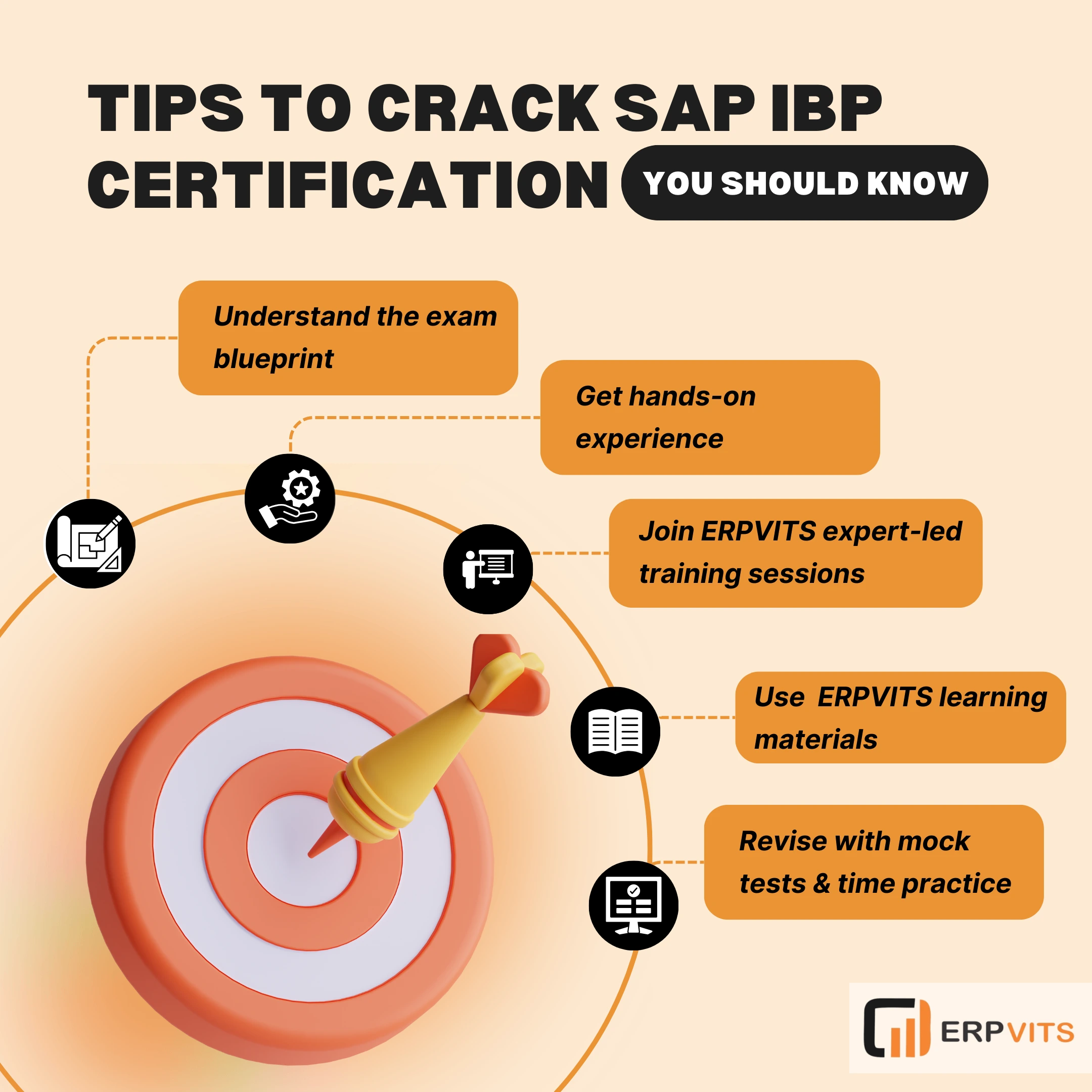
Step 1: Complete Official SAP Training
SAP offers authorized courses including:
- IBP10 – Introduction to SAP IBP
- IBP100 – SAP IBP for Demand
- IBP200 – SAP IBP for Sales & Operations Planning
- IBP300 – SAP IBP for Response & Supply
- IBP400 – SAP IBP for Inventory
These courses can be completed as instructor-led training (ILT) from ERPVITS or Best Online Career SAP training institutes
Step 2: Enroll with an Authorized Training Partner
Authorized training partners such as ERPVITS offer comprehensive SAP IBP training that includes live project scenarios and case studies, hands-on system access (sandbox environments), end-to-end implementation walkthroughs, and regular mock tests incorporating the latest SAP IBP certification questions.
Step 3: Gain Hands-On Experience
Theory alone will not suffice. Gain practical experience in a live SAP IBP environment by working through planning cycle exercises, configuring demand planning models, running inventory optimization scenarios, and exploring IBP Excel Add-in functionalities.
Step 4: Use Quality SAP IBP Certification Material
Invest in quality certification material that covers official SAP documentation and learning guides, chapter-wise practice tests, full-length mock exams, and topic-wise revision notes.
Step 5: Attempt the Certification Exam
Register through the SAP Certification Hub at certification.sap.com, select your exam, choose a date and test center or home testing option, and sit for your exam.
A Note on SAP IBP Certification Dumps – Proceed With Caution
Many candidates search for SAP IBP certification dumps online — pre-compiled sets of exam questions shared from past exam-takers. While such practices might help one get acquainted with exam formats, they come with important caveats:
- SAP regularly revises its exam question bank to counteract dump-based preparation.
- Using unauthorized dumps violates SAP's certification code of conduct and could result in disqualification.
- Many online "dumps" may contain outdated, inaccurate, or completely false material.
ERPVITS recommends that candidates focus on official SAP practice tests and reliable training providers for reputable practice questions. This approach not only ensures compliance but builds lasting knowledge that serves your career throughout.
SAP IBP Certification in India – Growing Demand & Career Opportunities
Indian enterprises and global MNCs have witnessed rapid growth in demand for SAP IBP certified professionals as SAP S/4HANA transformation projects and supply chain digitalization efforts accelerate.
Industries in India Hiring SAP IBP Certified Professionals
- Manufacturing & Automotive
- Consumer Goods & FMCG
- Pharmaceuticals & Life Sciences
- Retail & E-commerce
- Logistics & Supply Chain Services
Average Salary of SAP IBP Certified Professionals in India
| Experience Level | Average Annual CTC (India) |
|---|---|
| Fresher / Entry Level | INR 6 – 10 LPA |
| Mid-Level (3–6 Years) | INR 12 – 22 LPA |
| Senior / Expert (6+ Years) | INR 25 – 45 LPA |
SAP IBP certification holders in India are increasingly sought-after by leading IT service firms such as TCS, Infosys, Wipro, HCL, Accenture, Deloitte, and Capgemini, as well as end-user organizations managing large supply chains.
Why Choose ERPVITS for SAP IBP Training and Certification?
At ERPVITS, we have been supporting SAP professionals for more than a decade with industry-specific training programs, expert-led sessions, and job placement assistance. Here is what sets our SAP IBP training and certification program apart:
- ✅ SAP Authorized Training Content aligned with the latest exam syllabus
- ✅ Live Project Exposure with real IBP implementation scenarios
- ✅ Flexible Learning Modes – Online, Classroom, and Self-Paced
- ✅ Comprehensive Exam Prep Kits with mock tests and SAP IBP certification questions
- ✅ Expert Trainers with 10+ years of SAP IBP project experience
- ✅ Post-Certification Placement Support
- ✅ Affordable Packages with guidance on SAP IBP certification cost in India
Frequently Asked Questions (FAQs)
Q1. Is SAP IBP Certification Worth It in 2026?
Absolutely. As global supply chain complexity continues to expand, certified SAP IBP professionals are in high demand. Their credentials can open doors to consulting roles as well as managerial responsibilities that enhance career advancement opportunities.
Q2. What Is the Lifespan of SAP IBP Certifications?
Associate certifications never expire; however, SAP provides delta exams when major updates are released to ensure your certification remains valid and up-to-date. Staying current is key to remaining relevant in today's business environment.
Q3. Can I Prepare for SAP IBP Certification Without Work Experience?
Absolutely; however, it would be beneficial to gain at least basic exposure to supply chain planning concepts prior to beginning training. ERPVITS offers beginner-friendly courses that cover fundamental knowledge before delving deeper into IBP specifics.
Q4. How Many Attempts Are Allowed on the SAP IBP Exam?
SAP allows multiple attempts. Should you fail, after an appropriate cooling-off period you may reattempt after registering and making payment for another attempt. Each registration and fee payment are separate transactions.
Q5. Are SAP IBP Certification Dumps Reliable for Exam Preparation?
Unfortunately not. Dumps are unreliable, often out-of-date, and violate SAP's exam policies. To prepare successfully, use official SAP certification material or genuine practice question sets instead.
Q6. What Is the SAP IBP Certification Cost in India for 2026?
The approximate SAP IBP certification cost in India ranges between INR 30,000–45,000 per attempt. Contact ERPVITS for current pricing and discounted voucher options.
Start Your SAP IBP Certification Journey with ERPVITS
Earning your SAP IBP certification is a powerful step toward becoming a sought-after supply chain planning expert. With proper training, quality certification material, and frequent practice through SAP IBP sample questions, you can confidently pass on the first try.
ERPVITS is your trusted partner at every step — from exploring certification options to cost guidance.
Contact ERPVITS for a Free Counseling SessionALL CATEGORIES
RELATED BLOGS
Request More Info
Get expert guidance on your SAP career path.