
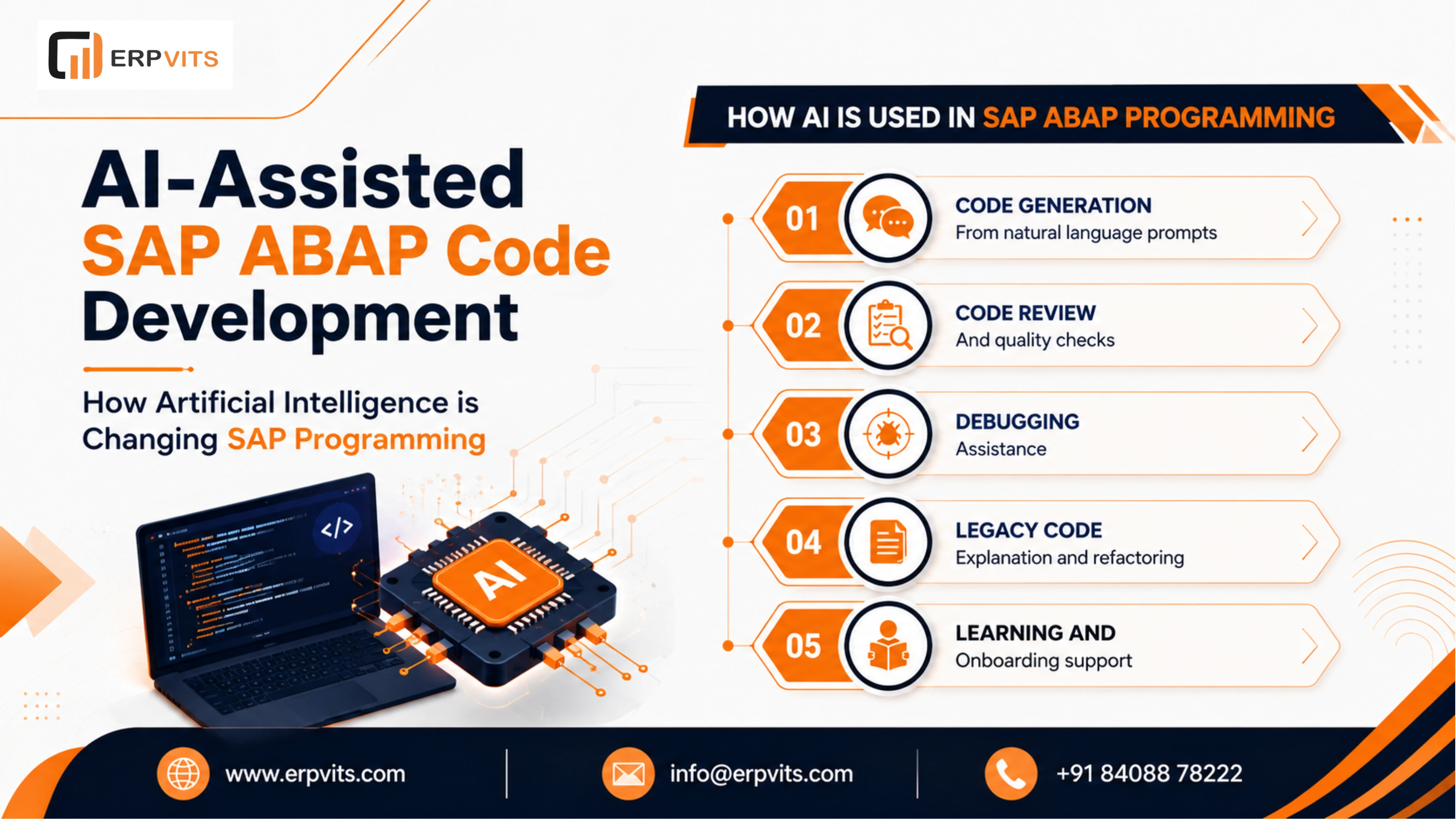
AI-Assisted SAP ABAP Code Development: How Artificial Intelligence is Changing SAP Programming
SAP development is experiencing one of the biggest changes in a long time, and it is not related to the introduction of a new module or new UI theme. It is all to do with the way SAP ABAP code is written and reviewed before being maintained. Artificial intelligence has evolved from a buzzword at SAP conferences to being a common tool in editors, where ABAP developers actually are working. When you are writing or editing or overseeing SAP ABAP code, understanding the shift in technology is no longer a luxury; it's fast becoming a part of your job description.
This blog explains the basics of what AI-assisted ABAP development really is, how it operates in real-world scenarios, what it means for businesses and developers, and what you'll need to know in the future if you wish to remain relevant in the current market.
What Does "AI-Assisted SAP ABAP Code" Actually Mean?
AI-assisted SAP ABAP code development refers to the use of machine learning models and large language models (LLMs) as well as intelligent automated tools that help developers write, optimise, debug and write ABAP programs. Instead of writing each line by hand, a programmer can express their requirements in plain English, and an AI assistant will generate drafts that contain code for SAP ABAP code, which the developer reviews before editing and submitting.
It's not all about retraining the programmer. It's about getting rid of the repetitive, low-value tasks -- routine syntax and loops and boilerplate, the basic CRUD logic and error handling -- so that attention is directed towards business logic, architecture decisions, and quality assurance, which is where the real expertise is still important.
SAP itself has taken a stab at this through SAP Joule, its intelligent AI copilot that is integrated into S/4HANA as well as the wider SAP ecosystem, as well as AI-powered functions within SAP's ADT, the ABAP Development Tools (ADT) in Eclipse. Beyond SAP's own tools, developers are also utilising general-purpose AI coders to write as well as refactor and provide explanations for the SAP ABAP programming language, specifically when it comes to custom development as well as older system tasks.
Why SAP ABAP Code Development Needed This Shift
ABAP was first introduced in the 1980s. And like any other mature languages, it's built up decades of conventions, heritage practices, and indigenous knowledge. There were a few issues that led to ABAP development being an ideal candidate to receive AI assistance:
Patterns of repetitive coding. A huge share of ABAP work involves writing the same structures over and over again inside table operation, BAPI calling, and ALV reports, as well as standard exception handling. AI tools can recognise these patterns in a flash and produce a draft of a new document within a matter of seconds.
Information gaps. Many SAP systems use code that was written decades or years back, usually with no notes. The understanding of old undocumented SAP ABAP code used to take long hours of manual tracking. AI models are now able to read an old block of code and explain its reasoning in simple English nearly instantly.
Onboarding pressure and talent. Experienced ABAP developers have a limitless amount of talent in their knowledge, and educating new developers to develop clean and efficient ABAP code has traditionally taken months. AI assistants function as a mentor who is always available, suggesting corrections, pointing out errors and helping beginners to understand SAP coding standards in real-time.
The complexity of S/4HANA is increasing. Cloud ABAP and RAP (RESTful ABAP Programming Model), as well as ABAP for SAP BTP, have created new concepts that even experienced developers are still adjusting to. AI tools that are trained on the current documentation can help you get over the learning curve more quickly than scouring through a plethora of forum threads.
How AI Tools Are Actually Used in SAP ABAP Programming
Let's look at how AI can be found in the development lifecycle, because that's where the majority of its practical value is realised.
1. Code Generation From Natural Language Prompts
A developer may define a need -- "create a report that selects all open sales orders for a given customer and displays them in an ALV grid." -The AI assistant will create a draft version that includes SAP ABAP code, including the SELECT command, the internal table declaration, and the ALV display logic. The developer can then tweak the names of variables, add authorisation checks and fine-tunes performance However, the bulk lifting of the initial draft is already completed.
2. Code Review and Quality Checks
Artificial intelligence-powered code review tools are able to examine SAP ABAP codes for typical issues like nested loops leading to performance bottlenecks, insufficient authorisation checks, values that are hard-coded or infractions to SAP's code-clean guidelines. The tool complements, but isn't a replacement for, SAP Code Inspector and ABAP Test Cockpit. SAP Code Inspector or ABAP Test Cockpit are still the best tools to detect security-related and syntax-related issues during transportation.
3. Debugging Assistance
When a programmer encounters unintentional output or a dump, pasting the relevant information and code into the AI assistant can reveal the probable cause quicker than manually going through the debugger starting from scratch. It's not a replacement for the ABAP debugger to solve complex problems with runtime; however, it can cut down that "Where do I even start looking?" process substantially.
4. Legacy Code Explanation and Refactoring
This is among the most beneficial scenarios in SAP environments. A lot of companies use custom-written code by developers who left their company several years ago. AI tools can provide a summary of the function modules that are not familiar with performance, detect obsolete syntax (like internal table declarations that are old-fashioned instead of modern declarations that are inline) and recommend modifications that align with the current SAP coding standards.
5. Test Case and Unit Test Generation
The writing of ABAP unit tests is often not done due to the pressure of time. AI assistants are able to generate basic unit test skeletons of an approach or class that developers can then modify to the actual business environment, which will result in better test coverage without adding additional hours to the work schedule.
6. Documentation Generation
After the code has been completed, AI tools can generate technical documentation, function specifications or even comments inside the SAP ABAP code itself, helping to reduce time spent on tasks. Developers are often unable to prioritise their work due to deadline pressure.
SAP Joule and Built-In AI: Where SAP Itself Is Headed
It's important to note that this doesn't just happen through third-party software. SAP's own roadmap invests heavily in integrating AI directly within the development environments. SAP Joule and AI capabilities in ABAP Development Tools are designed to aid with testing suggestions, code generation and even the ability to guide you through the migration process to RAP-based development in SAP BTP and S/4HANA Cloud. For companies that are on lengthy S/4HANA migration paths, the integrated AI help is turning into an effective accelerator for re-platforming customised ABAP code.
Benefits of AI-Assisted SAP ABAP Code Development
Rapider development times. Draft code that would have taken one hour now takes minutes, allowing developers to focus on edge cases and logic verification.
Lower barriers for new designers. Someone newer to ABAP will receive real-time, context-based explanations instead of relying on forums alone or availability of senior developers -- an important feature for anyone who is coming out of SAP ABAP online training or an organised SAP ABAP online course and applying concepts to real-world production situations.
Standards for coding that are consistent. AI tools trained on best practices guide developers to adhere to consistent naming conventions and proper modularisation and compliance with SAP ABAP coding standards across teams, thus reducing the "everyone codes differently" problem that is common to huge IT departments.
Better management of systems that are older. Companies running SAP for several years have thousands of custom-made programs that have no institutional expertise left in them. AI-assisted code explanation makes legacy maintenance far less painful.
Optimized code. AI suggestions around SQL performance, internal table handling along with parallel processing in SAP ABAP sample code scenarios can assist even experienced developers spot inefficiencies they may otherwise miss when under pressure to finish their work.
Limitations and Risks Developers Should Know
AI assistance isn't a complementary way to skip the basics, and using it in this way can pose a real risk for production SAP systems.
AI may generate plausible but untrue code that appears plausible but is not. A generated SELECT statement may compile, and possibly run, but it may not include the crucial WHERE clause condition or ignore authorisation checks or utilise an inefficient access pattern that is only visible when you scale it. Each suggestion must be reviewed by a professional who understands SAP ABAP code and the related business procedure.
Security and authorisation logic still requires human judgement. AI tools don't automatically know your organisation's authorisation concept, segregation-of-duties rules, or industry-specific compliance requirements. This is the security and development team's duty.
Efficiency for SAP HANA environments requires specific expertise. Generic AI suggestions will not always reflect SAP-specific optimisation methods like CDS views and AMDP as well as push-down processes. Software developers who work on SAP HANA ABAP optimisation of code require specialised training in order to verify AI output against specific best practices for HANA.
Privacy concerns for data. Pasting proprietary or sensitive SAP ABAP code into public AI tools could cause concerns about data governance. The company should set clear guidelines regarding what AI tools can be approved to be used internally for development purposes, particularly for codes that touch HR, financial or customer information.
What This Means for SAP ABAP Careers
The most common concern is that AI could take over ABAP developers. However, the reality is more of a changing of roles than eliminating them. The routine tasks of coding are being automated, and the demand for developers capable of validating AI output, developing systems architecture, and managing complex business logic as well as bridging the functional demands through technological implementation is growing.
This raises the standard of what "knowing ABAP" means. Employers advertising SAP ABAP jobs are increasingly seeking developers who can comprehend not only syntax but also system design as well as performance tuning, RAP, views of CDS, and, more recently, the best way to collaborate with AI coding assistants rather than trust them without regard.
If you're planning to interview in this field, you should know the fact that SAP Interview questions as well as responses are beginning to incorporate AI-related subjects, such as how to validate AI-generated code, ways to make use of AI for debugging without compromising data security, and how AI can be integrated into your everyday ABAP workflow. The structured learning that comes from an SAP ABAP online course or SAP ABAP online training programme is the primary foundation. AI tools are best used as an acceleration on top of that base and not as a substitute for it.
Practical Tips for Using AI Tools in ABAP Development
Certain traits separate those who make use of AI effectively from those who are burnt by AI:
Always examine artificial intelligence-designed SAP ABAP code in a development environment before deciding to make it production-ready, the same way you would test any other code written by hand. Examine the logic-generated line by line rather than believing it simply just because the logic "looks right" -- AI models can create syntactically correct but flawed logic. Make use of AI to draft first drafts and explanations, but not to authorise final approval or logic that is critical to security without expert oversight. Maintain your foundations; knowing why a particular part of your code works will help you spot AI errors that a less skilled developer could make. Keep up-to-date with the policies of your company regarding copying code from your own to outside AI tools.
The Road Ahead for AI in SAP Development
As SAP continues to push its S/4HANA Cloud, RAP, and BTP-based extensions, AI assistance is likely to be integrated in the normal development workflow instead of being viewed as a tool that developers use often. Expect tighter integration into ABAP Development Tools, smarter code review recommendations that are tied to SAP's clear fundamentals and AI-assisted tools for migration to help organisations move customised code that was developed on-premises ECC systems to SAP S/4HANA.
The best way for developers to go is by following the way ahead, which isn't just about avoiding these tools or completely relying on them It's about acquiring solid core ABAP capabilities first before mastering the use of AI to enhance productivity to add on that experience. The developers who will be noticed in the coming years are those who can write strong SAP ABAP code on their own and also know precisely when and how to integrate AI in the workflow in order to make it faster without sacrificing the quality.
If you're trying to create the solid ABAP foundation prior to adding AI tools over that, systematic guidance can make the difference. ERPVITS provides practical and interactive SAP ABAP training designed to aid learners to move from the core programming concepts to actual professional-ready capabilities -- exactly the kind of foundation that will make AI-assisted development an effective productivity boost instead of a gimmick.