
SAP FICO to S/4HANA Finance: What Changes and What Stays the Same
Since the beginning of time, SAP FICO (Financial Accounting and Controlling) has been the core of finance operations for enterprises across the world. It has provided organizations with a well-organized and reliable method of managing general ledger accounting as well as accounts payable and accounts receivable asset accounting, as well as control functions such as cost centers as well as profitability analyses. As businesses shifted to real-time reporting, simpler data models and cloud-first approaches, SAP introduced S/4HANA Finance -- a redesigned version of the SAP FICO system that rewrites the fundamentals of the way financial data is processed and stored.
For financial leaders, consultants and IT teams who have mastered the basics of SAP FICO , the transition to S/4HANA Finance can be simultaneously thrilling and daunting. Certain aspects change drastically. Some remain familiar. This article will explain the changes that occur during the SAP S/4HANA migration, what remains the same, and how businesses can ensure a smooth and seamless S/4HANA implementation process.
What is SAP S/4HANA Finance?
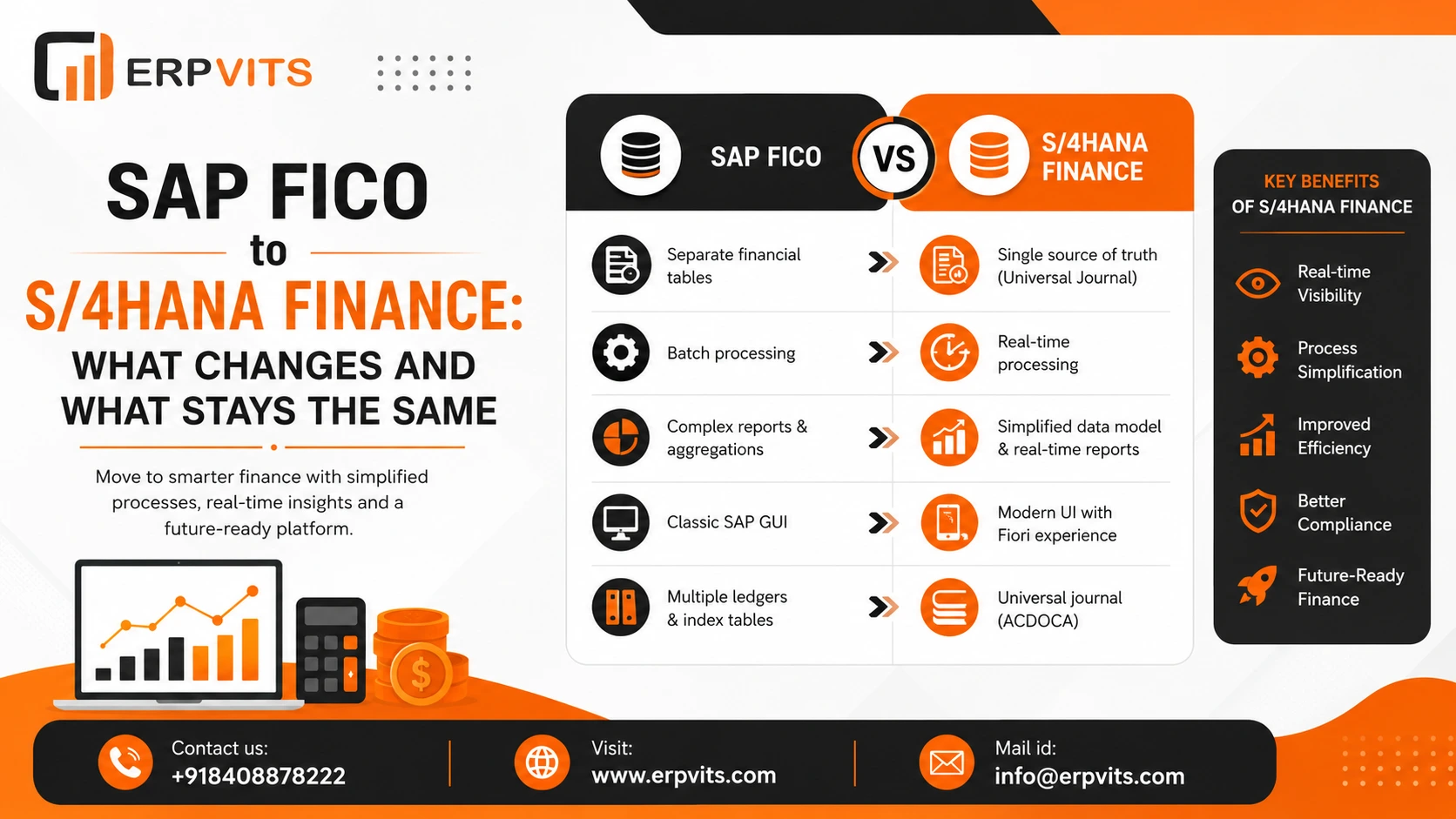
SAP S/4HANA Finance is the finance module designed specifically to work with SAP's in-memory HANA database, which replaces the old architecture that was used for SAP ECC and traditional FICO. It's not just an upgrade, it's a major overhaul of how controlling and financial data is stored, accessed and reported.
Here are the main aspects that define S/4HANA Finance:
- It combines the financial accounts (FI) and control (CO) into one unified data source, rather than maintaining them in separate tables.
- It is exclusively based on the HANA in-memory database, which allows the processing of data at a lightning speed with real time analytics.
- It eliminates the requirement for a myriad of traditional reconciliation and batch processing steps that SAP FICO consultants relied upon for many years.
- It introduces a simpler data model that reduces the amount of redundant data and reduces the overall footprint of the database significantly.
- It allows real-time financial reporting as well as embedded analytics, which allows finance teams to gain data instantly instead of waiting for batch jobs that are scheduled to run overnight.
- It was made to seamlessly integrate in conjunction with SAP Fiori, giving users an updated, role-based and easy-to-use interface, as opposed to the old SAP GUI only experience.
In simple words, S/4HANA Finance takes everything SAP FICO professionals are aware of about financial processes, and alters the underlying technology to make it more efficient as well as more transparent.
The Core Shift: Universal Journal (Table ACDOCA)
If there's a singular concept that defines the transition from traditional SAP FICO to S/4HANA Finance, it's the Universal Journal, technically represented in the ACDOCA table.
In the old FICO world, financial and controlling information resided in various tables - for instance, BSEG for accounting documents, COEP for controlling line items, as well as other tables that dealt with material ledger, asset accounting and profitability analysis. These tables needed to regularly reconcile which took time and led to divergences.
The Universal Journal changes this completely:
- It integrates FI, CO, Asset Accounting, Material Ledger, and Profitability Analysis data into one single line-item table.
- This eliminates the need to have a regular reconciliation between control and finance because both are able to draw from the same source of truth.
- It records data at the highest granular scale, meaning that each transaction has rich dimensions such as profit center, cost center, segment, and functional area in all of it.
- It is able to provide real-time drill-down reporting and allows users to take an account balance number straight to the original transaction without any delay.
- It greatly reduces the total footprint of data since redundant aggregates and tables are not required anymore.
This is the sole architectural change that is the reason S/4HANA Finance feels so different in the real world -- reports that required hours of reconciling can now be produced instantly with complete transparency across all financial dimensions.
What Changes in S/4HANA Finance
Although the Universal Journal is the headline change, a number of other significant shifts are also part of the SAP S/4HANA Finance transformation.
- General Ledger and Controlling are not separate entities anymore; postings are updated in real-time.
- Traditional transaction codes used for reconciliation, such as the ones used to match FI and CO postings, are no longer required since the data is unified.
- Cost elements are integrated into the chart of accounts, which means that the primary cost elements are just GL accounts, which simplifies the maintenance of master data.
- New Asset Accounting becomes the preferred method of adding asset postings directly to the Universal Journal instead of maintaining an individual ledger.
- The Material Ledger is now mandatory in the majority of configurations, which allows an efficient parallel valuation process and better inventory costing.
- Fiori-based apps replace a variety of traditional GUI transactions, providing tiled dashboards that are specific to roles and KPIs that are updated in real-time.
- Background reconciliation and batch jobs that consume system resources overnight have been eliminated in large part, which frees up processing time and reduces the risk of errors.
- Reporting tools are evolving as traditional reports are gradually being replaced by embedded analytics and applications built using real-time data.
Impact on FICO Consultants
Naturally, this change alters what is expected from SAP FICO consultants who work in an S/4HANA environment:
- Consultants must understand the Universal Journal structure deeply, because it has become the foundation of almost every control and finance process.
- Configuration knowledge shifts towards simpler customization, since many of the older configuration options and different configuration routes have been combined or eliminated.
- Consultants should become familiar with Fiori applications and their configuration because interaction between users happens through these tiles instead of traditional transaction codes.
- There is a necessity to comprehend real-time integration between different modules, because controlling, finance and logistics information now flow more tightly than they did before.
- Reporting expertise is shifting away from traditional reports towards embedded analytics, CDS views, and real-time dashboards.
- Consultants who work on SAP S/4HANA migration projects require the ability to handle data cleansing and conversion because historical data must be transformed to fit the new structure.
- Soft skills are also more important since consultants typically need to guide finance teams through major process and mindset shifts rather than just technical setup.
In short, the role of the SAP FICO consultant extends beyond being an expert in configuration to becoming an experienced advisor who understands both the technical architecture and the business implications of the new model.
Migration Approach: Key Considerations
Transitioning from classic SAP FICO to S/4HANA Finance is rarely a simple upgrade in terms of technology. This requires meticulous planning around the migration approach, data quality, and business continuity.
Greenfield vs Brownfield vs Bluefield
Companies typically select from three different SAP S/4HANA migration approaches, each with distinct advantages:
| Approach | What It Involves | Best Suited For |
|---|---|---|
| Greenfield | Building a new S/4HANA system from scratch, redesigning processes and configuration without carrying over previous customizations. | Companies that want an uncluttered start and are prepared to invest more effort upfront. |
| Brownfield | A technical conversion of the current ECC system to S/4HANA, preserving historical data and configuration as much as possible. | Organizations looking for an easier transition with minimal disruption to existing processes. |
| Bluefield | A hybrid method allowing selective data migration and process redesign without a full rebuild or a straight technical conversion. | Companies that want the benefits of a fresh start in specific areas while retaining valuable data elsewhere. |
The best approach to take will depend on factors such as the age of the system, the degree of technical debt, willingness for process change, budget, and timeframe.
Data Migration Challenges
Regardless of the method chosen, data migration remains among the more challenging aspects of any SAP S/4HANA Finance project. The most common challenges are:
- Master data that is inconsistent or duplicated, built up over time in the legacy system.
- Historical transactional data that is complex and needs to be correctly mapped to the new Universal Journal structure.
- Enhancements and custom fields developed in the previous system that might not have a direct replacement in S/4HANA.
- Integrations and interfaces with other systems that must be tested and adjusted in line with changes to the data model.
- Reconciliation between old and new systems during the parallel run period, in order to build confidence before the cutover.
Cleansing Legacy Master Data
Before any data can be transferred to S/4HANA, it requires extensive cleansing:
- Duplicate customer, vendor and material records must be identified and merged whenever feasible.
- Master data that is inactive or outdated should be flagged, and then archived or excluded from migration.
- Fields that are non-standardized or inconsistent, such as tax classifications or payment terms, must be standardized.
- The chart of accounts and cost element structures must be reviewed and re-aligned to the simplified S/4HANA model.
- Data owners in procurement, finance and sales must be involved in the early stages, as master data quality is a responsibility that spans across all functions and not just an IT-related task.
Cleansing master data should not be only a once-in-a-while activity. It is best to make it an ongoing governance practice even after go-live.
Handling Open Items During Cutover
Invoices as well as payments and postings that are not yet cleared present an unusual challenge during a SAP S/4HANA migration because they reflect real financial obligations.
- Open accounts receivable and accounts payable items have to be properly carried forward in order to ensure that there are no duplicate or missing entries.
- A clear cutover plan will define precisely which items are migrated as open, and which ones are cleared prior to the cutover deadline.
- Timing is important, as transactions made during the cutover window require special processing to prevent them from being duplicated or lost.
- Reconciliation reports must be run before and after the cutover in order to ensure that open item balances are in line between the old and the new system.
- Clear communication with finance departments is crucial, as they need to know what transactions to pause or defer during the transition window.
Example -- Open AR/AP Items During Cutover Weekend
Imagine a company planning its weekend cutover with a go-live date set for Monday morning.
- At the end of Friday, the legacy system is closed for new postings, and a final extract of all open AR and AP items is retrieved.
- Over the weekend, the data is cleansed, mapped, and loaded into the new S/4HANA system using the appropriate migration tools.
- Any invoices or payments received during the weekend through manual or emergency processes are recorded separately and incorporated into the new system once it goes live.
- On Monday, the finance team conducts reconciliation checks, comparing the open AR and AP balances in the new system with the final report from the legacy system.
- Once the numbers match and any discrepancies are resolved, the finance team confirms the cutover is complete and resumes normal business operations in S/4HANA.
This case illustrates how cutover planning can't be viewed as a solely technical undertaking. It requires close coordination between the finance and migration teams to ensure that no financial information is lost or duplicated during the transition.
Final Thoughts
The switch from SAP FICO to S/4HANA Finance isn't just a software upgrade, it's a change in how companies perceive financial information. The Universal Journal eliminates silos between control and finance, real-time reporting replaces long batch cycles, and consultants move from being configuration specialists to strategic advisors. In the same way, the fundamental financial principles that SAPl FICO experts have relied on -- accurate postings, sound reconciliation procedures, and solid master data governance -- remain as vital as ever.
Businesses that invest the time in thorough planning, meticulous data cleansing, and a well-planned SAP S/4HANA migration strategy will discover that S/4HANA Finance isn't just a different version of FICO, but a significant advancement in the way finance operates.