
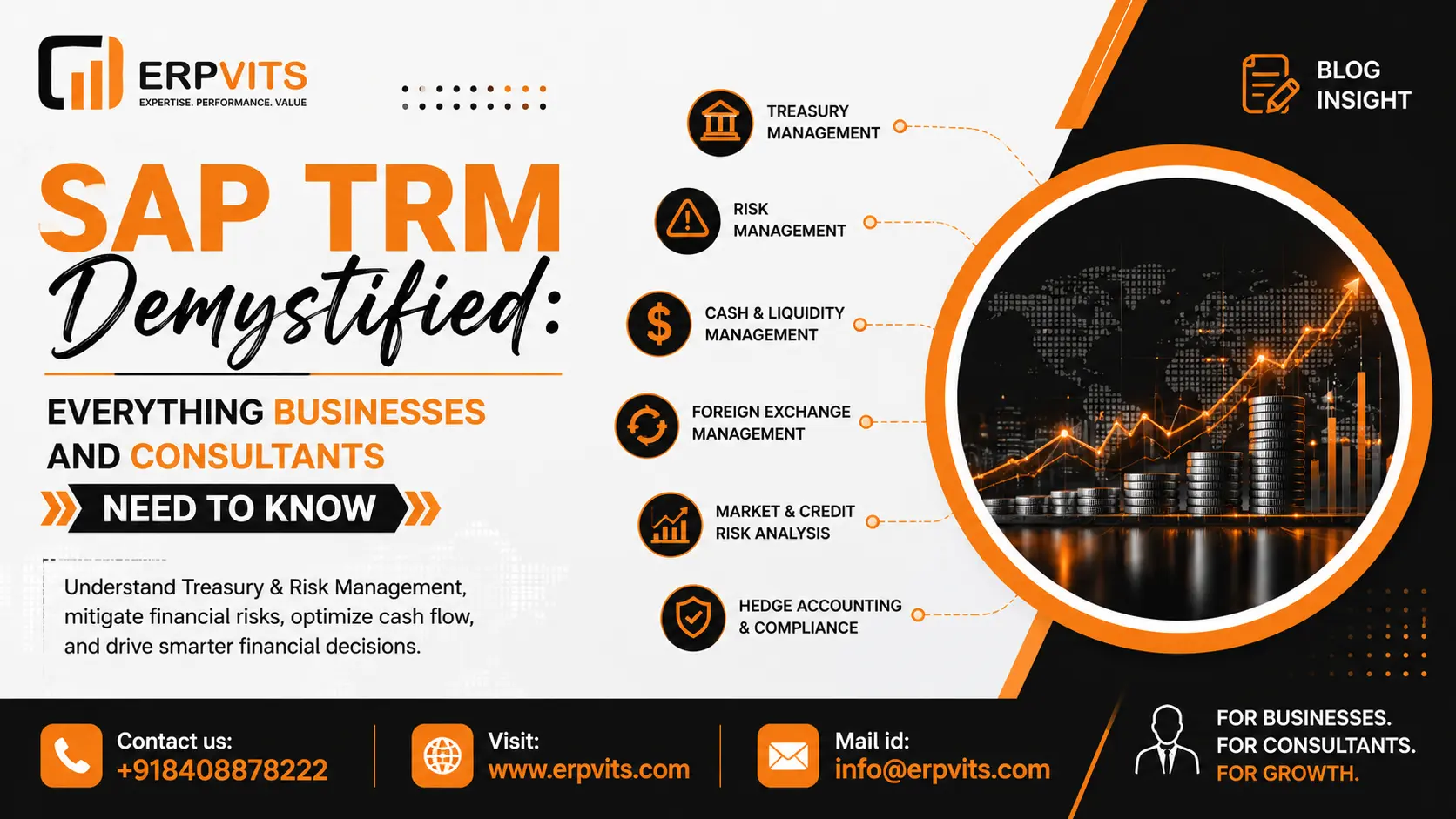
SAP TRM Demystified: Everything Businesses and Consultants Need to Know
A practical guide to SAP Treasury and Risk Management, its connection to revenue management, and what it takes to build a career as an SAP TRM consultant.
What is SAP TRM and Why It Matters Today
Each business, no matter the size of its business or sector, is concerned with money movements that includes payments coming into the system, and payments going out and loans being served and refinanced, and exchanges of currency. The larger and more global an organization is, the more complicated the financial web becomes. SAP Treasury and Risk Management helps to manage this complexity. It's not only software for the Treasury department; it's a tower of control for the overall business's financial health.
What is the reason it matters to us today? Because the environment that businesses operate in has become more unpredictable. Rates of interest change quickly and currencies fluctuate depending on geopolitical developments, and the risk of credit from partners or customers could be discovered in a matter of hours. Businesses that rely on manually-tracking spreadsheets or unconnected systems are typically the last ones to recognize an issue — but at the time they notice, it could become too late for them to act. SAP TRM changes that by providing the finance and treasury departments an up-to-date and connected overview of the financial risk a company faces, which means that risks are detected earlier and opportunities aren't missed.
Definition and Core Purpose of SAP Treasury and Risk Management
SAP TRM can be best described as a distinct layer within the finance suite of SAP that is focused on only three things including handling financial transactions, assessing the risk and managing it, and ensuring that the business remains in compliance with the financial regulations.
To further break it down
It serves as a central repository in which each financial transaction — an unpaid loan or a bond issued or a forward contract to exchange currency, or a swap contract — is documented, tracked, valued, and monitored.
It constantly calculates how vulnerable the business is to changes in the market. This ensures that leaders are aware of the effects of interest rate increases and currency appreciation, as well as the price of commodities.
It guarantees that if auditors or regulators are requesting information, the company produces precise, traceable documents instead of scrambling to reconcile data from different sources.
Evolution of SAP TRM: From Classic Treasury to S/4HANA
To fully appreciate the work SAP TRM can do in the present, it is important to know the origins of SAP TRM.
This development demonstrates the clear direction that shows how treasury management has evolved from a manual recording function to an intelligent, real-time decision-making system.
Key Components of SAP TRM
Transaction Manager
Consider the Transaction Manager as the engine room for SAP TRM. Each financial transaction that a company is involved in — whether it's borrowing cash, investing excess cash, or hedging the risk of currency fluctuations — is handled by this section. It takes care of the entire cycle, including capturing the transaction, verifying it with the counterparty, making it available to back offices, and finally, posting it into the accounting records. Without this element, the treasury department isn't able to keep track of deals and where they stand.
Market Risk Analyzer
Markets change constantly and every move has an impact on the financial situation of a company. This Market Risk Analyzer measures how sensitive the portfolio of a company is to fluctuations in exchange rates, interest rates, and prices for commodities. It basically answers this question: "If the market moves this much, how much could we gain or lose?" This allows treasury teams to make educated hedging decisions instead of reacting once the damage has already been done.
Credit Risk Analyzer
Not every risk comes from the marketplace — others are brought on by companies and people whom you trade with. This Credit Risk Analyzer evaluates the quality of the financials and reliability of your counterparties, identifies the limits of credit, and alerts when the exposure to a specific partner is becoming too large. This is particularly important for businesses that provide credit conditions or are involved in significant financial contracts with other entities.
Portfolio Analyzer
After all risks and transactions are identified individually, the Portfolio Analyzer consolidates everything into an all-encompassing view. It lets treasury managers see the big picture — how the whole portfolio of loans, investments, and financial instruments is doing, and whether the risk justifies the profits generated.
Hedge Management
Many businesses employ hedge strategies to safeguard themselves from unfavorable market fluctuations, for example, locking in a currency rate in advance. Hedge Management within SAP TRM is not only a resource for creating these hedges but also makes sure they are documented properly and tested for their effectiveness, which is a requirement of accounting regulations. This keeps the company financially safe and audit-ready.
How SAP TRM Works: Core Processes
Cash and Liquidity Management
In the simplest sense, the business must be aware of the amount of funds it holds, where the cash is, and how much is available over the next days or weeks. SAP TRM consolidates cash positions of every banking account as well as business entity into a single overview and forecasts future cash flow based upon expected receipts and payments. This avoids unpleasant surprises, such as finding that there isn't enough cash available to cover the cost of payroll or payments to suppliers.
Financial Instrument Management (Bonds, Derivatives, Forex, etc.)
Each financial instrument that a business holds — be it a government bond, a currency forward contract, or an interest-rate swap — is required to be tracked, beginning from the time it's issued until it either matures or is closed out. SAP TRM manages this entire journey by ensuring that every instrument is valued correctly and properly accounted for and disclosed, without relying on manual spreadsheets, which are susceptible to mistakes.
Risk Identification and Mitigation
This process runs in the background. SAP TRM monitors market conditions and the behavior of counterparties around the clock, and when something breaches a specified threshold — such as a currency's movement outside the acceptable limit — it sends out alerts. The treasury team then has the chance to react, adjusting an investment, changing the conditions, or advising top management of a rising risk.
SAP TRM and Revenue Management: The Connection
Treasury and revenue management may look like two distinct worlds, but they are, in fact, closely connected.
How Treasury Data Impacts Revenue Forecasting
The company's cash flow, outstanding receivables, and exposure to currency all impact the amount of revenue it is likely to be able to capture and collect. For instance, a business with a large number of foreign currency sales could see its revenue diminish or increase due to fluctuations in exchange rates, which treasury information tracks in real time. If revenue managers are able to access this treasury data, forecasts are more grounded in the reality of financial transactions instead of optimistic expectations.
Improving Cash Flow Visibility for Better Revenue Decisions
When revenue and treasury departments are able to work with the same data in real time, decisions are made more efficient all over the board. Sales personnel can feel more confident giving credit terms because they know the cash position will be able to absorb any delay. Finance departments can time expansions or investments more efficiently because they understand the patterns of cash flow inflows. This helps eliminate the uncertainty that traditionally sat between departments that collaborate in silos, tying treasury and revenue management closer together.
Benefits of Implementing SAP TRM for Businesses
SAP TRM Implementation: Key Considerations
| Common Challenges During Implementation | Best Practices for a Smooth Rollout |
|---|---|
| Moving historical finance data from outdated spreadsheets or systems can be a mess, particularly when the data was not standardized initially. | Make sure you have a thorough analysis of current treasury procedures prior to any configuration, so the system is designed around real business needs instead of generic templates. |
| Setting up risk parameters correctly requires extensive knowledge, as even minor errors in credit or market risk settings could lead to inadequate risk assessment. | Involve finance, treasury, and IT personnel in the project from the beginning, because decisions made in isolation can result in expensive work-arounds later. |
| Treasury personnel who are used to manual procedures may be resistant to switching to a different process, particularly if they feel it will increase complexity instead of reducing it. | Prioritize cleansing and validating the data prior to migration, as poor quality data could undermine even the most well-designed system. |
| Connecting SAP TRM to existing banking platforms as well as external data feeds is technically difficult, especially for businesses with multiple banking relationships across various countries. | Make sure you have enough time for testing, particularly around hedge accounting and risk analytics, because these are the areas that are most complicated and most scrutinized in audits. Also invest time and money in training so that once the system is operational, personnel can profit from its features instead of falling back to traditional practices. |
Role and Scope of an SAP TRM Consultant
What Does an SAP TRM Consultant Do?
An SAP TRM consultant sits at the crossroads of finance knowledge as well as technical setup. Their day-to-day routine often involves collaborating with a treasury staff member of the client to determine the way they manage cash, risk, and financial instruments, and translate those requirements into a correctly configured SAP system. Beyond the initial installation, an SAP TRM consultant is frequently called upon to create strategies for managing risk, connect SAP TRM with various modules such as Financial Accounting and Controlling, and assist with any issues that arise following the launch.
Key Skills and Certifications Required
| Skill Area | What It Covers |
|---|---|
| Treasury & Instrument Knowledge | A thorough understanding of treasury operations and financial instruments — knowing not only what a bond or swap actually is, but also how it performs financially over time. |
| Configuration Experience | Practical, hands-on experience configuring SAP TRM, which includes the Transaction Manager and numerous Risk Analyzers. |
| Integration Knowledge | Experience with how SAP TRM integrates with SAP S/4HANA Finance and other modules, as treasury seldom functions in isolation from other finance functions. |
| SAP Accreditation | A valid SAP certification is a sign of credibility in treasury and risk management, demonstrating credibility to clients and employers. |
| Accounting Standards | A working knowledge of accounting standards like IFRS 9, particularly around hedge accounting, as this is typically one of the most technically demanding aspects of the job. |
Career Growth and Opportunities in SAP TRM
Since treasury functions are essential to nearly every major company, from banks to manufacturers to retailers across the world, demand for experienced SAP TRM consultants remains robust. Many consultants start out in functional support positions before moving on to more intricate design and configuration work as they progress toward solution architecture or treasury transformation leadership posts. Because this particular skill set is more specialized compared to general SAP financial consulting, skilled experts in this field typically find themselves well paid and sought-after.
SAP TRM vs Other Treasury Solutions
Why Enterprises Choose SAP TRM Over Competitors
There are a variety of treasury management systems available on the market, but why do large companies select SAP TRM?
| Reason | What It Means for the Business |
|---|---|
| Seamless Integration | It integrates naturally with the current SAP ERP as well as S/4HANA system, avoiding the necessity to create and maintain separate middleware to connect different systems. |
| Unified Platform | It blends treasury management as well as risk management and accounting into one platform instead of requiring businesses to join various disconnected tools. |
| Built for Complexity | It is designed to manage the challenges of multi-entity, large multi-currency companies operating across multiple countries and regulatory settings. |
| Continued Investment | SAP is continuing to put a lot of money into its cloud strategy, giving companies confidence that their infrastructure will keep evolving rather than becoming obsolete. |
| Established Ecosystem | There's a vast, established ecosystem of certified consultants and implementation partners, making it easier to get support than with small, niche treasury companies. |
Future of SAP TRM
SAP TRM in S/4HANA and Cloud Solutions
SAP is clearly heading toward an era where treasury capabilities reside increasingly in the cloud. This change gives businesses more flexibility, speedier deployment times, and less reliance on expensive on-premises infrastructure. Many companies, particularly smaller ones that had previously found a treasury management system too expensive or complicated, are finding that cloud-based SAP TRM makes sophisticated treasury management much more accessible.
Emerging Trends: AI, Automation, and Predictive Analytics in Treasury
In the future, the most interesting developments in SAP TRM will involve the use of intelligence, not only automation. Artificial intelligence is now beginning to play a part in predicting cash flow patterns before they occur, instead of simply reporting on what has already happened. Machine learning models can identify suspicious transactions that could indicate an error or fraud, usually quicker and more precisely than human reviewers could. Predictive analytics are being used to help treasury managers anticipate market risks before they become apparent, moving treasury from a reactive service to an incredibly strategic one.
Bringing It All Together
SAP TRM sits at the center of how modern businesses manage cash, risk, and revenue management together, rather than as separate concerns. For businesses, it delivers visibility and control that manual processes simply can't match. For an aspiring SAP TRM consultant, it represents a specialized, in-demand career path that combines financial expertise with technical skill — one that will only grow more valuable as treasury and risk management continue moving toward the cloud and intelligent automation.