
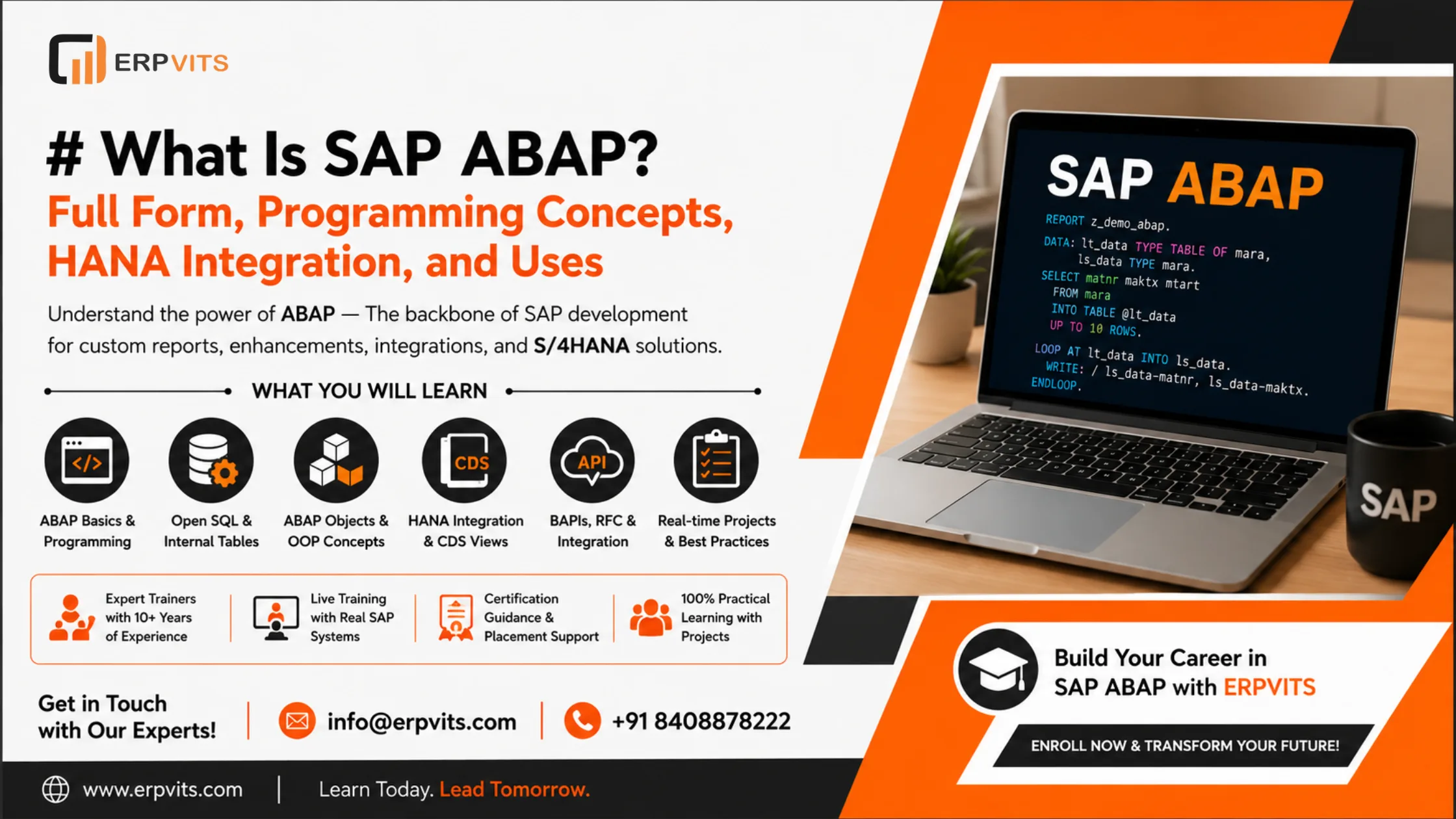
What is SAP ABAP? Exploring the Full Form, Programming Concepts, HANA Integration, and Applications
If your career goal is to become an SAP consultant, one of the first things you need to understand is: what is SAP ABAP?
SAP ABAP is the programming language that allows you to create, develop, and modify almost all SAP applications. If you have to automate an HR workflow, integrate procurement, or create a financial report, and you do it within an SAP system, you'll have ABAP code working for you as well.
ABAP is an acronym for Advanced Business Application Programming, and, unlike Java or Python, ABAP is an enterprise-specific programming language. This language works within the SAP application server, natively communicates with SAP's database, and effortlessly integrates with all its modules (e.g. FI, MM, SD, HR, PP, etc.).
In this article, we at ERPVITS will guide you through everything you need to know about SAP ABAP, including the full form, and core programming concepts, as well as what SAP ABAP is used for, and how it works with SAP HANA.
What is the Full Form of SAP ABAP?
Let's begin with the basics.
Originally, ABAP was a German acronym for Allgemeiner Berichts-Aufbereitungs-Prozessor translating to General Report Preparation Processor, which references the first use of the language in the early 1980s for SAP's R/2 business reporting modules, which was a mainframe-based ERP application.
ABAP blossomed with SAP. When SAP R/3 was launched in 1992, the language evolved and the name was changed to reflect the new language features, being full of new programming constructs, and was known as Advanced Business Application Programming.
Break down the full form, and:
| Word | What It Means |
|---|---|
| Advanced | A high-level programming language with the capability of supporting complex business logics |
| Business | Supports the business functions of: finance, logistics, and human resources |
| Application | Supports the development of application-layer programs within SAP |
| Programming | A full-fledged programming language with a syntax and a toolchain of its own |
The purpose of SAP ABAP is not as a general-purpose programming language or a generic domain scripting language. It is a specialized programming language in support of programming for the scale and complexity of a multinational enterprise.
A Brief History: How SAP ABAP Evolved
In order to understand what SAP ABAP is today, you need to understand a little of what it was.
1983 — Creation of Report Generator
ABAP was created to run on IBM mainframes as part of SAP R/2. It was created to produce printed business reports. Developers would write simple procedural code to extract the record they wanted from the database.
1992 — Impact of the R/3
With SAP R/3, ABAP was part of the client-server architecture. ABAP was further extended and developers could write full applications rather than just reports. ABAP could handle more complex database queries and could create an interactive screen using Open SQL and dynamic programming (Dynpro).
2000s — Arrival of Object Orientation
ABAP gained the full support of OOP (Object Oriented Programming). With the introduction of ABAP Objects, ABAP gained the features of encapsulation, abstraction, and inheritance. Exception handling was also introduced. With the addition of these features, ABAP became comparably sophisticated to Java and C# for Enterprise Application Development.
2013–2016 — 7.4 and 7.5 Versions
With the release of ABAP 7.4 and 7.5, ABAP gained many features that simplified its syntax. Features such as inline variable declaration, string templates, table expressions, and other functional constructs like SWITCH and COND were also introduced. ABAP Open SQL also gained significant improvements. With the release of these versions, writing ABAP became more modern. Compared to the code written in the 1990s, the procedural code of modern ABAP is very different.
2015–Present — S/4HANA and Cloud ABAP
With the release of SAP S/4HANA, ABAP gained Core Data Services (CDS) Views, the Restful ABAP Programming Model (RAP), and ABAP for BTP (Business Technology Platform). With further optimization for the SAP HANA in-memory database, ABAP gained several cloud-based, API-oriented features. Currently, ABAP is a high-performance programming language that is actively being developed by SAP.
What Is SAP ABAP Programming?
So, what is SAP ABAP programming? Well, similar to other programming languages, it consists of writing code in the SAP environment to create or customize features for business use. Here, we will explore the concepts that an ABAP programmer will most likely work on.
1. The ABAP Workbench and Eclipse ADT
In the traditional sense, ABAP programming was done in the SAP GUI ABAP Workbench (transaction SE80). This workbench contains all the needed editors for programs, function groups, classes, data dictionary objects, and screens.
ABAP programmers often prefer the ABAP Development Tools (ADT). This tool provides an Eclipse-like IDE that supports CDS Views, RAP objects, unit testing of ABAP classes, and development on the cloud in the BTP. In many cases, both tools will be used depending on the system landscape.
2. ABAP Program Types
There are several different types of programs supported by ABAP:
- Executable Programs (Reports): Directly executed programs that generate an output
- Module Pools: Programs that generate complex user interfaces based on screen levels
- Function Groups: Program modules that contain a collection of Function Modules
- Class Pools: Programs that contain global classes of the Object Orientation
- Include Programs: Programs that contain code segments that can be included in other programs
3. Data Types and Internal Tables
One of the most recognizable data types in ABAP is the internal table. Similar to the results of a database query, and similar to a spreadsheet, an internal table is a data type that is stored in memory within ABAP, and can be manipulated with code. There are three types of internal tables:
- Standard Table: Uniqueness and order is not enforced, accessed in any order
- Sorted Table: Uniqueness is enforced, always sorted by key, accessed via binary search
- Hashed Table: Uniqueness is enforced, accessed in the order of the hash, sorted by key
With the recent updates to ABAP, the internal tables feature became significantly easier to use:
" Declare and populate in one step
DATA(lt_orders) = VALUE ty_orders_tab(
  ( order_id = 1001 customer = 'ERPVITS Client A' amount = 50000 )
  ( order_id = 1002 customer = 'ERPVITS Client B' amount = 75000 )
).

" Read a single row using table expression
DATA(ls_order) = lt_orders[ order_id = 1001 ].
4. Open SQL
ABAP developers use Open SQL for database table access. Open SQL is a database-independent SQL dialect. SAP's runtime translates Open SQL to the native SQL of the underlying database (Oracle, MSSQL, DB2, or HANA). This allows database-independent code from ABAP for SAP database migrations.
SELECT order_id, customer, amount
  FROM zsales_orders
  INTO TABLE @DATA(lt_results)
  WHERE amount > 10000
  ORDER BY amount DESCENDING.
5. ABAP Objects (OOP)
ABAP's object orientation covers all the classic pillars of OOP:
- Encapsulation: Attributes and methods may be scoped as public, protected, or private
- Inheritance: Subclasses may extend the behavior of a superclass
- Polymorphism: Interface reference may hold objects of different types
- Exception Handling: Class-based exceptions are used instead of the old sy-subrc method
CLASS lcl_invoice DEFINITION.
  PUBLIC SECTION.
    METHODS: calculate_tax IMPORTING iv_amount TYPE i
                           RETURNING VALUE(rv_tax) TYPE i.
ENDCLASS.

CLASS lcl_invoice IMPLEMENTATION.
  METHOD calculate_tax.
    rv_tax = iv_amount * 18 / 100.
  ENDMETHOD.
ENDCLASS.
6. Function Modules, BAPIs, and RFCs
Function Modules are the standard ABAP unit of reusable, callable business logic. A Function Module may be made callable from external systems (not only other SAP systems, but even Java and other third-party systems) if it is made Remote Function Call (RFC) enabled.
BAPIs (Business Application Programming Interfaces) are RFC-enabled Function Modules that are SAP's standard interface for the core business functions (create a purchase order, post a financial document, read employee data) and BAPIs are the foundational Function Module for all SAP integrations.
What Is SAP ABAP HANA?
What is SAP ABAP HANA? It means SAP ABAP development combined with the SAP HANA in-memory database on which SAP S/4HANA is built.
SAP HANA: A Quick Overview
SAP HANA (High-Performance Analytic Appliance) is an in-memory columnar database. With SAP HANA, processing data happens extremely quickly, because data is retained in memory (as opposed to being written to a disk). In the case of traditional, row-based, relational databases, large data sets can slow down processing.
How ABAP Changed for HANA
When SAP developed S/4HANA on HANA, they changed the way ABAP is processed in their databases. The guiding principle is code-to-data: instead of loading large result sets into memory and processing them in ABAP loops, developers push data processing logic to the HANA database, where processing is done more efficiently.
With this approach, ABAP HANA introduced two main elements:
CDS Views (Core Data Services)
CDS Views are data models written in the ABAP Development Tools. These views are rendered as database views on HANA. With CDS Views, ABAP developers can create database views that have joins and filters and define aggregations as well as analytical calculations. These views can then be used in Fiori applications, OData Services and other ABAP Development Tools artefacts.
@AbapCatalog.sqlViewName: 'ZSALES_RPT'
@Analytics.dataCategory: #CUBE
define view ZCDS_SALES_REPORT as
  select from vbak
  {
    vbeln as SalesOrder,
    erdat as CreatedOn,
    netwr as NetValue
  }
  where netwr > 0
ABAP SQL (Enhanced Open SQL)
SAP enhanced Open SQL for HANA is a major upgrade for Open SQL, bringing new capabilities such as:
- Aggregate functions (SUM, AVG, MAX, MIN, COUNT) in SELECT
- GROUP BY and HAVING clauses
- CASE expressions inside SELECT
- Window functions for analytical calculations
- JOIN syntax directly in Open SQL
This gives the power to ABAP developers allowing them to write queries on HANA directly in ABAP without the need to switch to Native SQL.
The Restful ABAP Programming Model (RAP)
RAP is the strategic framework from SAP for building transactional Fiori applications and OData V4 services on S/4HANA. RAP leverages CDS Views for the data model, ABAP classes for Business Logic, and a behaviour definition language to provide CRUD operations as managed or unmanaged services. RAP is the future of ABAP application development on the SAP BTP and S/4HANA.
What Is SAP ABAP Used For?
This might be the most important question when thinking about ABAP in business and the answer is simple:
1. Custom Report Development
Developing custom reports is the most common use case of ABAP. While standard SAP reports satisfy most reporting needs, there is always a need for specific reporting in each organization. Using ALV grids, classical lists, or web-based output, ABAP developers create custom reports that display the required information for end users in the organization.
2. User Exits, BADIs, and Enhancements
SAP allows customers to add custom code in several places without changing the delivered programs. Using User Exits, Customer Exits, BADIs, and Enhancement Spots, ABAP developers can add business rules, like validating a purchase order field, setting a default value on a sales order, or posting a notification to a user for a goods receipt.
3. Interface and Integration Development
Companies use many systems along with instances of SAP. ABAP developers perform integration work using:
- IDocs, which is SAP's standard messaging format for EDI and communication between systems
- BAPIs and RFCs for synchronous calls between systems
- Web Services (SOAP/REST) for API calls
- SAP Cloud Platform Integration (CPI) where ABAP services are backend to the cloud integration
4. Data Migration
All implementations of SAP require data to be migrated from legacy systems. ABAP is used to create LSMW (Legacy System Migration Workbench) scripting, BDC (Batch Data Communication) programs, Direct Input programs to migrate master data (materials, vendors, and customers) and transactional data (orders and balances) into SAP.
5. Workflow Development
SAP Business Workflow provides automation for multi-step approvals. ABAP developers provide the logic for routing and conditions for step completion and for the escalation of workflows for purchase order approvals, leave requests, invoice verification, and other workflows.
6. Form Development (SAPscript, SmartForms, Adobe Forms)
Every business document that SAP sends out — be it a purchase order, invoice, delivery note, payslip, etc. — utilizes an ABAP form program. Developers create form layouts and write ABAP code to fill them with the correct data when the form gets printed or when a PDF version gets created.
7. Performance Tuning and Code Optimisation
On big SAP systems that process millions of records, bad ABAP code can be a big performance threat. With the help of the SAT (ABAP Trace), SE30, and ST05 (SQL Trace) tools, ABAP developers can detect these performance issues and improve bad ABAP code by correcting bad SELECT statements, removing unnecessary loops, and addressing bad access to tables.
8. S/4HANA Migration and Modernisation
While organizations are migrating from SAP ECC to S/4HANA, ABAP developers will run SAP Readiness Check and ABAP Test Cockpit (ATC) to check for codes that contain old style ABAP, old function modules, and code that is not optimized for HANA, which will need to be brought up to specifications before a go-live scenario.
SAP ABAP Career Opportunity: Why It Still Matters in 2026
With SAP having over 400,000 customers worldwide, and with every major industry having large-scale S/4HANA migration projects, the need for ABAP developers is growing. In India, entry-level ABAP positions are starting at ₹4–6 LPA, while experienced S/4HANA and RAP developers earn salaries between ₹18–30 LPA, and even more. Around the world, some of the highest-paying SAP positions are for ABAP consultants.
At ERPVITS, we provide a comprehensive SAP ABAP training course that takes you through the all important first steps and all the way to programming skills needed for real SAP ABAP projects, including core concepts, ABAP Objects, ALV Reporting, ABAP Enhancement Framework, CDS Views, and RAP.
Conclusion
So, what is SAP ABAP? In short, it is Advanced Business Application Programming, and it is the language developed by SAP for use in their business applications. With its roots in SAP's report generation tool, it has evolved over 40 years to a complete OOP language and continues to grow with Cloud capabilities, BTP, and HANA.
So, what is SAP ABAP programming? It is the development of logic in SAP for business needs in the form of reports, enhancements, interfaces, data migrations, forms, workflows and S/4HANA applications.
Simply, what is SAP ABAP HANA? It is the combination of ABAP with HANA and SAP's in-memory database, combined with RAP, and opens up even more possibilities for businesses that want faster, more efficient and intelligent applications.
It is easy to see what SAP ABAP is used for. It is used for anything from basic user exits to complex cross-industry integrations as well as S/4HANA modernisation projects.
If you want to learn SAP ABAP to build a career in one of the most in-demand sectors in enterprise IT, we at ERPVITS will prepare you for the journey.
Enroll in our SAP ABAP on HANA Online Training. It includes live training, real SAP system access and career guidance.